
Exploring Lake Geneva by Train: The Lavaux Vineyards, Vevey, Montreux and Chillon

Some railway journeys are spectacular because they climb into mountains.
Others succeed because they remain close to the water.
The route along the northern shore of Lake Geneva belongs firmly in the second category.
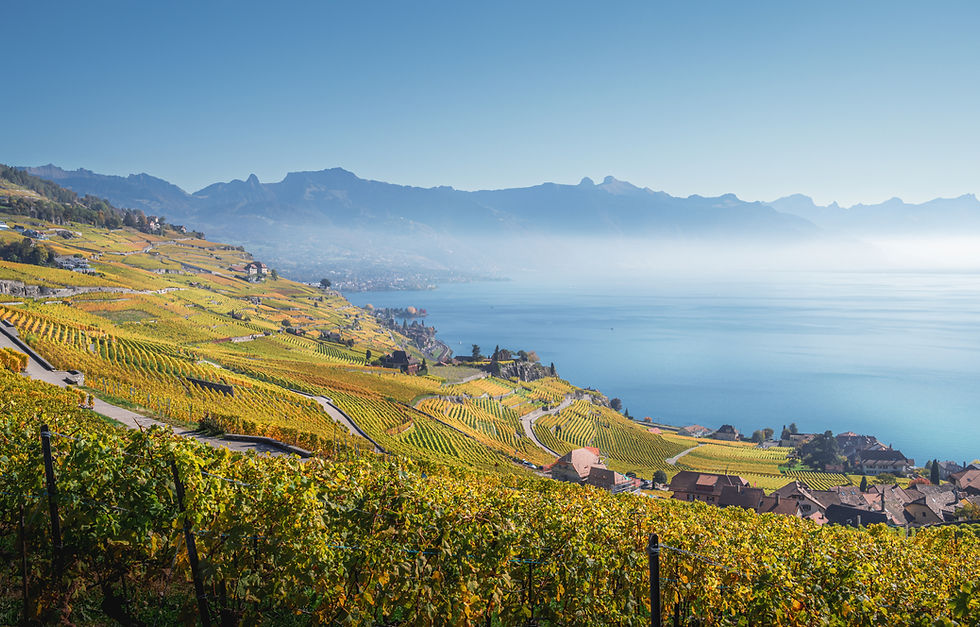
Leaving Lausanne, trains slip between terraced vineyards and the lake, passing stone villages, church towers and rows of vines that descend almost impossibly towards the water.
Across the lake, the French Alps rise in the distance.
Ahead lie Vevey, Montreux and Chillon Castle.
It is one of Switzerland’s most elegant rail journeys.
But the real pleasure comes from getting off.
The Lavaux vineyards are threaded with railway stations, walking trails and tiny wine villages, making it possible to explore this UNESCO-listed landscape entirely without a car.
You can begin the morning in Lausanne.
Walk through vineyards above Lake Geneva.
Stop for a tasting in Cully, Epesses or Saint-Saphorin.
Continue by train to Vevey.
Spend the evening on Montreux’s lakeside promenade.
Then visit Chillon Castle by train, bus or boat the following morning.
Few journeys demonstrate the freedom of Swiss rail travel more clearly.
Why This Journey Is So Special
Lake Geneva is enormous.
From the shore, it often feels more like an inland sea than a lake.
The water changes constantly with the weather, shifting from silver to deep blue, while the Alps rise beyond the opposite shore.
Between Lausanne and Montreux, however, another landscape competes for attention.
The Lavaux Vineyard Terraces cover the steep slopes above the lake, creating one of Europe’s most distinctive wine regions.
Stone walls support narrow ribbons of vines.
Small villages sit between the terraces.
Railway lines run at different levels across the hillside.
Below, passenger boats move slowly between lakeside towns.
The entire landscape feels beautifully interconnected.
Train, vineyard, village, lake and mountain all remain visible at once.
A Landscape Shaped Over Centuries
Wine has been grown around Lake Geneva since Roman times, but the landscape visible today owes much to medieval monastic communities.
From around the 11th century, monks developed and expanded the terraced vineyards, constructing stone walls and drainage systems across the steep slopes.
Generations of growers continued that work.
The result is not a natural wilderness but a carefully shaped cultural landscape created through centuries of human labour.
Lavaux was added to the UNESCO World Heritage List in 2007 in recognition of that relationship between people, wine and terrain.
The protected area contains roughly 800 hectares of vineyard terraces stretching between Lausanne and the Montreux Riviera.
What makes the region particularly remarkable is how difficult the land is to cultivate.
Many vineyards are too steep or narrow for conventional machinery.
Work is still carried out largely by hand, with small vineyard railways and monorails used in places to move workers and grapes up the slopes.
This helps explain why Lavaux wines are produced in relatively small quantities and why so little is exported.
The Three Suns of Lavaux
Local winegrowers often speak about the “three suns” of Lavaux.
The first is the sun in the sky.
The second is the light reflected from Lake Geneva.
The third is the warmth stored by the vineyard walls and released gradually after sunset.
Together, they create a distinctive microclimate that helps grapes ripen on these steep, lake-facing slopes.
The dominant variety is Chasselas.
It produces pale, dry white wines that are subtle rather than powerful, often with mineral notes that reflect the different soils and villages of the region.
For travellers accustomed to better-known French or Italian wines, Chasselas can be a revelation.
It suits the landscape perfectly.
Light.
Fresh.
Quietly distinctive.
Getting There by Train
Lausanne makes the most practical starting point.
From Geneva, frequent direct trains reach Lausanne in roughly 35–45 minutes.
From Bern, the journey normally takes a little over an hour.
From Zurich, direct trains generally take around two hours and fifteen minutes.
Once in Lausanne, regional trains provide easy access to the Lavaux villages and onward destinations around the lake.
Direct trains from Lausanne to Vevey take roughly 15–20 minutes, while Montreux can be reached in around 20–25 minutes. Services are frequent throughout the day.
For walking in the vineyards, useful stations include:
Lutry
Cully
Epesses
Rivaz
Saint-Saphorin
Chexbres-Village
Vevey
The exact route depends on how far you want to walk and whether you prefer to begin above the vineyards or near the lake.
Check the SBB app before travelling, as not every train stops at every small station.
Which Side of the Train?
Travelling from Lausanne towards Vevey and Montreux, sit on the right-hand side of the train for the best lake views.
The line stays close to Lake Geneva for much of the journey.
At times, vineyards rise steeply above the tracks.
At others, the lake opens almost directly beside the carriage.
On clear days, the French Alps appear beyond the water.
The journey is short, so do not bury your phone or camera in your bag.
The views begin quickly after leaving Lausanne.
The Best Way to Explore Lavaux
The smartest approach is not to stay on one train all day.
Use the railway as the spine of the journey.
Choose one vineyard walk.
Stop in one or two villages.
Allow time for lunch or a wine tasting.
Then continue towards Vevey or Montreux.
Trying to visit every village turns an elegant day into a timetable exercise.
Lavaux is most rewarding when experienced slowly.
Option One: Cully to Epesses
For a gentle introduction, take the train from Lausanne to Cully.
Cully is one of the most attractive lakeside villages in Lavaux, with a compact historic centre, waterfront promenade, cafés and easy access to the vineyards.
From here, walking paths climb through the terraces towards Epesses.
The route is not long, but it rises steadily and offers increasingly impressive views across the lake.
Epesses feels smaller and more closely connected to wine production.
Stone houses gather around narrow lanes, while vineyard paths spread in several directions above and below the village.
After exploring, you can return to the railway at Epesses station or continue walking towards Rivaz.
This is an excellent option if you want scenery without committing to a long hike.
Option Two: Saint-Saphorin to Lutry
More active walkers can follow part of the classic route between Saint-Saphorin and Lutry.
The full walk covers around 11 kilometres and normally takes a little over three hours, excluding stops.
It involves both climbing and descending, so good footwear is important.
The reward is one of the finest vineyard walks in Switzerland, passing stone villages, vineyard walls and constantly changing views across Lake Geneva.
You do not need to complete the entire route.
Because the railway runs below the vineyards, you can shorten the walk by finishing at Rivaz, Epesses or Cully.
That flexibility is one of the greatest advantages of exploring Lavaux by train.
Option Three: The Wine Train Above Vevey
Another excellent option is to approach Lavaux from above.
The regional R7 line runs between Vevey and Puidoux through Chexbres-Village, offering elevated views across the vineyards and lake.
SBB describes the short descent from Chexbres towards Vevey as one of the highlights of the region, with the journey taking around ten minutes.
This line is particularly useful if you prefer a scenic train ride to a longer walk.
Get off at Chexbres-Village, explore the village and surrounding viewpoints, then continue down towards Vevey.
For an even higher perspective, the funicular from Vevey to Mont-Pèlerin offers broad views over the vineyards and Lake Geneva.
The Lavaux Express
Visitors who want to see the vineyards without a substantial walk can also consider the Lavaux Express.
This small tourist train travels through the vineyard landscape on selected routes from villages such as Cully or Lutry.
It is not part of the regular SBB railway network, but it provides an easy introduction to the terraces, particularly for families or travellers with limited mobility.
Services are seasonal, and reservations are advisable.
Cully: The Best All-Round Stop
If you only choose one Lavaux village, Cully is probably the most practical.
It has a railway station.
It sits directly beside the lake.
The old centre is attractive without feeling like a museum.
And vineyard paths begin almost immediately behind the village.
Cully is also associated with the annual Cully Jazz Festival, which brings concerts to cellars, cafés and venues across the village each spring.
Outside festival dates, the atmosphere is calm and distinctly local.
Spend time by the waterfront before climbing into the vineyards.
The contrast between the quiet harbour and the steep slopes above captures the character of Lavaux beautifully.
Epesses and Rivaz
Epesses and Rivaz offer a more intimate experience.
These villages feel embedded within the vineyards rather than simply beside them.
Narrow streets climb between stone houses and cellars.
Small signs advertise tastings.
Views appear unexpectedly at the end of lanes.
Rivaz is particularly useful for visiting Lavaux Vinorama, which presents wines from producers across the region and offers tastings without requiring appointments at several individual estates.
It is a practical stop for travellers who want to learn about Lavaux wine rather than simply admire the scenery.
Saint-Saphorin
Saint-Saphorin is one of the most beautiful villages along the route.
Stone buildings cluster tightly around a small church, with vineyards rising behind and the lake directly below.
The village has appeared in paintings, travel writing and photography for generations, yet it remains remarkably peaceful outside busy summer weekends.
Its station sits below the village, so expect a climb.
The reward is an atmosphere that feels almost timeless.
Saint-Saphorin works particularly well as the starting point for a vineyard walk towards Rivaz, Epesses or Cully.
Wine Tasting Without Driving
Lavaux is ideally suited to wine tasting by rail.
Because the villages are connected by frequent trains, there is no need to nominate a driver or rely on taxis.
However, many producers are small family businesses rather than visitor attractions.
Opening hours can be limited.
Some cellars welcome walk-ins at particular times, while others require advance reservations.
Check before travelling.
The regional caveaux, or communal wine cellars, are often the easiest option.
They showcase wines from several local growers and provide a broader introduction to the appellation.
Remember that Lavaux wine is produced on difficult terrain and in limited quantities.
Prices reflect the work involved.
Treat tastings as an opportunity to understand the region rather than search for inexpensive bottles.
Continue to Vevey
After exploring the vineyards, continue by train to Vevey.
The journey from Lausanne takes as little as 14–18 minutes, and trains run frequently.
Vevey has a gentler atmosphere than Montreux.
Its old streets, market square and lakeside promenade feel lived in rather than resort-like.
The town has long attracted artists, writers and wealthy residents, but it remains approachable.
Walk along the lake to see the famous giant fork standing in the water outside Alimentarium, the food museum created by the Nestlé Foundation.
The promenade offers beautiful views across the lake, particularly in the late afternoon.
Charlie Chaplin and Vevey
Charlie Chaplin spent the final decades of his life above Vevey at Manoir de Ban.
The house and estate are now home to Chaplin’s World, a museum combining his personal history, film career and reconstructed studio sets.
It is not directly beside the railway station, but buses connect from Vevey.
Allow at least half a day if you plan to visit properly.
For cinema lovers, it is one of the most engaging museums in Switzerland.
Vevey’s Old Town and Market
Vevey’s Grande Place is one of the largest market squares in Switzerland.
On market days it fills with local produce, flowers and food stalls.
The surrounding streets contain cafés, bakeries and small shops, while the lakeside lies only a few minutes away.
Vevey works well as a lunch stop or overnight base.
It is quieter than Montreux but remains exceptionally well connected by train and boat.
Continue to Montreux
From Vevey, Montreux is only around five or six minutes away by train.
The contrast is immediate.
Montreux feels more theatrical.
Belle Époque hotels line the waterfront.
Palm trees and flowers soften the promenade.
Mountains rise sharply behind the town.
The lake opens towards the Rhône Valley and the distant peaks beyond.
Montreux’s reputation as a resort grew during the 19th century, when wealthy European visitors came for the mild climate and scenery.
That international character remains visible today.

The Montreux Lakeside Promenade
The lakeside promenade is one of the loveliest urban walks in Switzerland.
It stretches past gardens, sculptures, hotels and small beaches, with continuous views across the water.
Do not treat it merely as a route between attractions.
Allow time to sit.
Watch the boats.
Notice how the mountains change as the light moves.
The Freddie Mercury statue has become one of the most photographed landmarks in town.
Mercury spent considerable time in Montreux and recorded with Queen at Mountain Studios inside the casino.
The Queen Studio Experience now occupies part of the former studio space.
Montreux Jazz Festival
Montreux is internationally known for its Jazz Festival, held each summer.
What began as a jazz event expanded into one of Europe’s most famous music festivals, welcoming artists from almost every genre.
The town becomes extremely busy during festival dates, so book accommodation well ahead.
Even outside the festival, Montreux’s musical history remains part of its identity.
Chillon Castle
No Lake Geneva journey is complete without visiting Château de Chillon.
Set directly on the water near Montreux, it is one of Switzerland’s most recognisable historic buildings.
The castle occupies a strategic position between the lake and mountains, controlling the route through the Rhône Valley for centuries.
Its towers, courtyards, underground chambers and lakeside setting make it far more rewarding than a brief photo stop.
From Montreux or Vevey, bus 201 stops directly outside the castle every 10–20 minutes.
Regional trains also serve Veytaux-Chillon, followed by a short walk.
In peak season, CGN boats call near the castle, creating the most atmospheric arrival of all.

Arriving at Chillon by Boat
If schedules align, travel to Chillon by boat and return by train or bus.
This avoids repeating the same route and gives you the classic view of the castle from the water.
CGN operates passenger boats and historic vessels across Lake Geneva, with seasonal services linking Lausanne, Vevey, Montreux, Chillon and Villeneuve.
Timetables vary considerably by season, so check the 2026 schedule rather than assuming a particular boat will operate.
This combination of train and boat is one of the most enjoyable ways to explore the lake.
Other Places Around Lake Geneva
The Swiss side of Lake Geneva contains far more than Lausanne, Vevey and Montreux.
Geneva itself deserves several days for the old town, international district, lakeside parks and museums.
Nyon offers a compact old town, Roman history and a castle overlooking the lake.
Across the water, the medieval French village of Yvoire can be reached by boat from Nyon.
Évian-les-Bains is linked with Lausanne by regular passenger ferry, with the crossing taking around 35 minutes.
Villeneuve, beyond Chillon, offers a quieter lakeside atmosphere and marks the eastern end of the lake.
The beauty of the region is that trains and boats allow you to combine these places without a car.
A Perfect Two-Day Lake Geneva Itinerary
Begin in Lausanne.
Take a morning train to Cully or Saint-Saphorin.
Walk through the Lavaux vineyards, stopping in Epesses or Rivaz for lunch and a tasting.
Continue by train to Vevey.
Walk the lakeside and explore the old town.
Spend the night in Vevey or Montreux.
The following morning, explore Montreux’s promenade before taking the bus, train or boat to Chillon Castle.
Return by a different route.
Finish with dinner beside the lake or continue onwards by train towards Geneva, Bern or Valais.
This gives you vineyards, villages, lake scenery, history and rail travel without trying to fit too much into one day.
Where to Stay
Hotel Lavaux, Cully
Hotel Lavaux sits in the heart of the UNESCO-listed vineyard landscape, only a short walk from Epesses station.
Its contemporary rooms make the most of the setting, with many overlooking the lake and Alps.
The panoramic terrace is particularly appealing in the evening, when the vineyards begin catching the last light.
It is the strongest option for travellers who want to wake inside Lavaux rather than simply visit for the day.
@hotellavaux
Beau-Rivage Palace, Lausanne
For a grand lakeside stay, Beau-Rivage Palace remains one of Switzerland’s most celebrated hotels.
Set in extensive gardens beside the lake in Ouchy, it combines historic architecture, refined service and views towards the French Alps.
It is also home to the acclaimed restaurant Pic au Beau-Rivage Palace.
@beaurivagepalace
Grand Hotel Suisse Majestic, Montreux
Directly opposite Montreux railway station, Grand Hotel Suisse Majestic could hardly be more convenient for rail travellers.
Its Belle Époque character, lake-facing rooms and broad terrace make it an excellent base for Montreux, Chillon and the eastern end of the lake.
@hotelsuissemajestic
Where to Eat
Restaurant Tout un Monde, Grandvaux
Perched above the vineyards, Tout un Monde is known for its sweeping terrace views across Lavaux and Lake Geneva.
The cooking draws on regional ingredients with a contemporary approach, while the setting makes it one of the most memorable places to dine in the wine region.
@toutunmondelavaux
Le Baron Tavernier, Chexbres
Set high above the lake, Le Baron Tavernier combines a hotel, wine bar and restaurant with one of Lavaux’s most dramatic panoramas.
It works particularly well for lunch after a vineyard walk or an evening drink while the light changes across the terraces.
@barontavernierhotel
Pic au Beau-Rivage Palace, Lausanne
For a special occasion, Pic au Beau-Rivage Palace offers refined cuisine overlooking the lake.
Anne-Sophie Pic’s restaurant combines precise contemporary cooking with the elegance of one of Lausanne’s landmark hotels.
@beaurivagepalace
Le Deck, Chexbres
Le Deck is famous for its terrace overlooking the vineyards and lake.
The menu is polished but approachable, and the view alone makes it a memorable stop during a Lavaux journey.
@barontavernierhotel
Montreux Jazz Café
In Montreux, the Jazz Café provides an energetic alternative to traditional Swiss dining.
Music memorabilia, international dishes and a relaxed atmosphere connect the restaurant directly with the town’s festival identity.
@fairmontlemontreuxpalace
Insider Tips
Travel from Lausanne towards Montreux on the right-hand side of the train for the best lake views.
Do not try to visit every Lavaux village in one day.
Choose one walk and allow time to stop.
Wear proper shoes.
The vineyard paths can be steep, uneven and slippery after rain.
Bring water, particularly in summer.
There is limited shade on parts of the terraces.
Check wine-cellar opening times in advance.
Small producers do not always operate regular visitor hours.
Use the SBB app to shorten walks if the weather changes or your timing slips.
Check CGN boat schedules separately, as lake services vary by season.
If staying in a hotel within the Montreux Riviera or Lavaux area, ask whether a local guest card is included. Some properties provide regional transport benefits, although the exact validity varies.
Visit in September or early October for harvest atmosphere and warm vineyard colours.
Spring is excellent for walking.
Summer offers the fullest boat schedule but also the largest crowds.
Why This Journey Works So Well
The Lake Geneva railway shows Switzerland at its most effortless.
The trains are frequent.
The distances are short.
The views begin almost immediately.
And every stop reveals a different side of the region.
Lausanne brings energy and culture.
Lavaux offers vineyards and villages.
Vevey feels graceful and lived in.
Montreux adds music and Belle Époque glamour.
Chillon provides history in one of the most dramatic settings in the country.
You can experience all of it without hiring a car.
More importantly, the journey never feels like a series of disconnected attractions.
The lake ties everything together.
Exploring Switzerland by Train
The Lavaux vineyards and Lake Geneva are exactly the kind of destinations that make Switzerland so rewarding to explore by rail.
The landscape is spectacular, the connections are simple, and trains allow you to move easily between cities, wine villages, castles and lakeside promenades without worrying about parking or driving.
For more scenic journeys, independent itineraries, practical booking advice and hidden destinations, see Touring Switzerland by Train.
Find the guide here:
You can also discover more rail journeys and slow-travel inspiration at:
Follow along at:
@real_travel_guides


Comments