
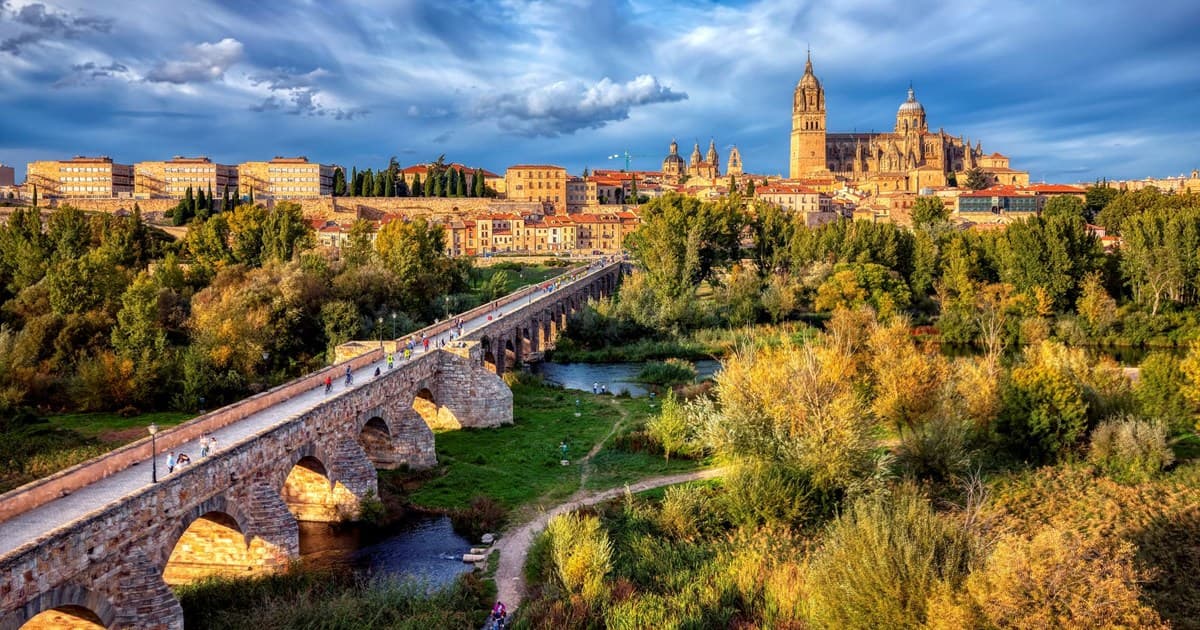
Madrid has no shortage of tempting day trips.
Toledo has El Greco and its extraordinary hilltop setting. Segovia has its Roman aqueduct and fairytale Alcázar. But travel a little further west and you reach somewhere that feels quite different.
Salamanca.
Less than two hours from Madrid on the fastest direct trains, this beautiful university city is built from warm Villamayor sandstone that seems to change colour throughout the day. There are medieval university courtyards and Renaissance palaces, two cathedrals joined together, convents hidden behind high stone walls and one of Spain's great Baroque squares.
And then there are the students.
Salamanca isn't a historic city preserved behind glass. Its university still brings thousands of young people into the centre, filling cafés and bars and giving streets that are hundreds of years old a remarkably youthful atmosphere.
You can see Salamanca on a day trip from Madrid.
But we wouldn't.
Stay for one night and something changes. The day-trippers leave, the sandstone turns gold in the evening light, students reclaim the streets and the illuminated Plaza Mayor becomes one of the most atmospheric places in Spain.
This is a city that deserves an evening.
Why Salamanca?
Salamanca's importance goes far beyond its architecture.
Its university was founded by King Alfonso IX in 1218, making it one of the oldest universities in Europe. For centuries Salamanca became one of the great intellectual centres of the Spanish-speaking world, its scholars debating theology, law, economics, astronomy and the profound moral questions raised by Spain's expansion into the Americas.
That intellectual history remains embedded in the city.
Yet Salamanca is surprisingly manageable.
Most of its important sights sit within a compact historic centre, making this an ideal place to explore without a car, taxis or complicated public transport.
Arrive by train, leave your bag and walk.
Getting from Madrid to Salamanca by Train
Direct Renfe trains connect Madrid Chamartín-Clara Campoamor with Salamanca.
Journey times vary considerably according to the service, so when booking, look carefully at the duration rather than simply choosing the first departure displayed. The fastest direct services make the journey in under two hours, while slower regional trains take considerably longer.
For an overnight trip, we'd take a morning train from Madrid and return during the afternoon or early evening the following day.
That gives you almost two complete days in Salamanca without changing hotels more than once.
Book directly with Renfe:
It's worth booking ahead if you're travelling at a weekend or during a particularly busy period.
Salamanca railway station sits northeast of the historic centre. You can walk into town in around 20–25 minutes, although with luggage it's easy to take a local bus or taxi and start exploring once you've checked in.
Day 1: Begin in Plaza Mayor
Don't start with a museum.
Start with coffee in Plaza Mayor.
Completed during the 18th century, Salamanca's great Baroque square is the city's living room rather than simply a monument. Arcaded walkways run beneath its façades, cafés spill into the square and students cross it on their way between lectures.
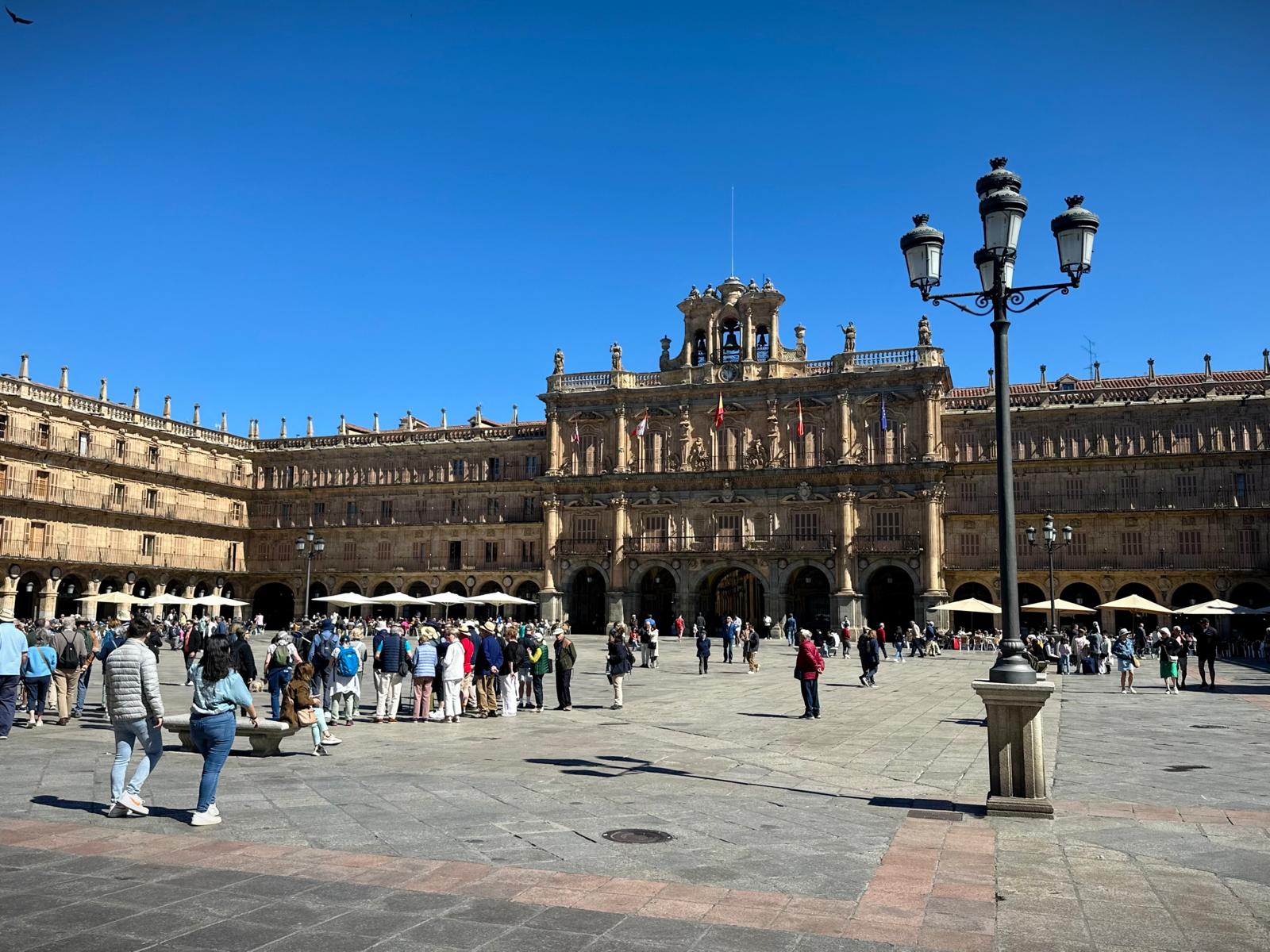
Walk through during the morning.
But remember what it looks like.
You'll come back tonight.
From here, follow Calle Rúa Mayor towards the university quarter. Almost immediately, the modern shopping streets give way to the Salamanca you've come to find: narrow lanes, carved stone façades and glimpses of towers above the rooftops.
The University of Salamanca: Look Beyond the Frog
Eventually you'll emerge into the small courtyard-like space facing the extraordinary façade of the University of Salamanca.
Stop here.
Don't immediately start looking for the frog.
The university was founded in 1218, and its Historic Building can be visited today. The magnificent façade was added in the early 16th century and is one of the finest examples of Spanish Plateresque architecture — stone carved with such extraordinary intricacy that it resembles the work of a silversmith.
Inside, you can enter historic lecture rooms, including the preserved classroom of the 16th-century scholar and poet Fray Luis de León.
Then you can look for the frog.
Hidden among the dense carvings is a tiny frog sitting on a skull.
Finding it has become a Salamanca ritual.
Students traditionally believed that spotting the frog without assistance would bring academic success. Other versions promise marriage, good luck or a future return to Salamanca.
The original meaning is far less certain.
There are several competing interpretations, including the idea that the frog and skull represented a moral warning to students about temptation, discipline and mortality. The precise intention of the 16th-century sculptor remains disputed.
That uncertainty makes it more interesting.
Spend a while looking at the whole façade before finding the frog.
As Salamanca's former rector Miguel de Unamuno essentially complained, anyone who sees only the frog has missed the point.
Step Inside the University
Don't stop at the façade.
The university is worth visiting inside precisely because the rooms remind you that this wasn't simply a palace — people actually studied and argued here.
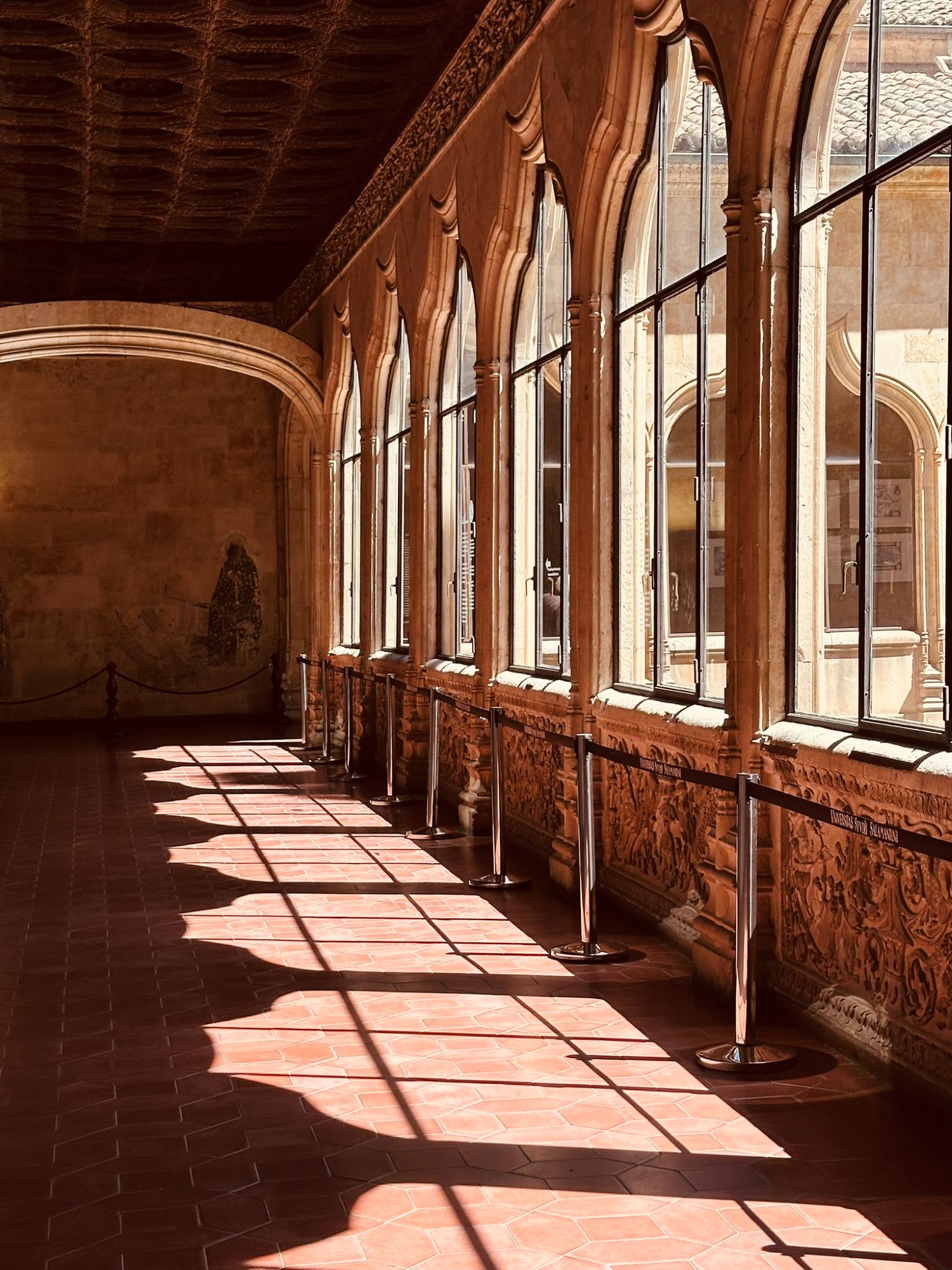
The old lecture rooms are wonderfully austere compared with the exuberant façade outside.
Imagine generations of students sitting on wooden benches listening to lectures in Latin.
One of the most evocative spaces is the classroom associated with Fray Luis de León, the Augustinian friar, poet and university professor imprisoned by the Spanish Inquisition.
According to Salamanca tradition, when he returned to his classroom after several years' imprisonment, he resumed his lecture with the wonderfully understated words “Dicebamus hesterna die…” — “As we were saying yesterday…”
Whether the phrase was actually spoken is debated.
But it is difficult to stand in the room without wanting the story to be true.
Casa de las Conchas
From the university, walk towards the Casa de las Conchas.
You can't really miss it.
More than 300 stone scallop shells cover the façade of this late-15th-century palace. The shells are associated with the Order of Santiago, to which the building's founder was connected.
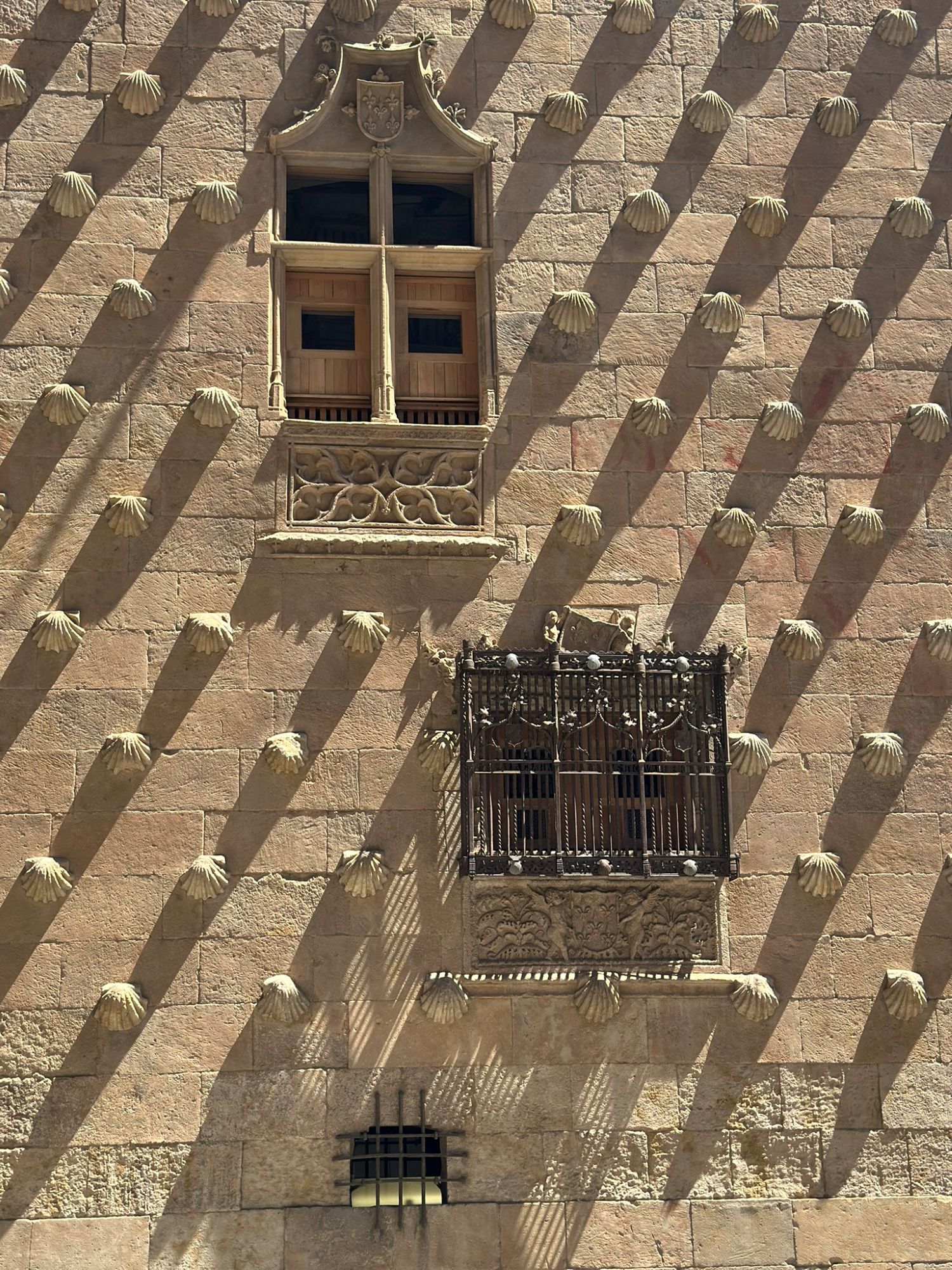
The architecture itself sits at the transition between Gothic and Renaissance Spain, with Mudéjar influences woven into the design.
Today it houses a public library.
Go inside.
The courtyard is lovely, entrance is free, and it gives you another glimpse behind Salamanca's elaborate stone façades.
Lunch Like a Salmantino
This is Castilla y León, so lunch is not the moment to look for a salad and rush back to sightseeing.
Salamanca has an excellent food scene ranging from old-fashioned tapas bars to Michelin-starred restaurants.
For something casual, look for hornazo, Salamanca's savoury pastry traditionally filled with pork, chorizo and egg.
Another local speciality is farinato, made principally from breadcrumbs, pork fat, paprika and spices and traditionally served with fried eggs.
For contemporary tapas, Tapas 3.0 is a good choice close to the historic centre.
Or save your appetite for tonight.
Because staying overnight means you can actually enjoy dinner without checking the time of the last train to Madrid.
Two Cathedrals for the Price of One
Salamanca doesn't have one cathedral.
It has two.
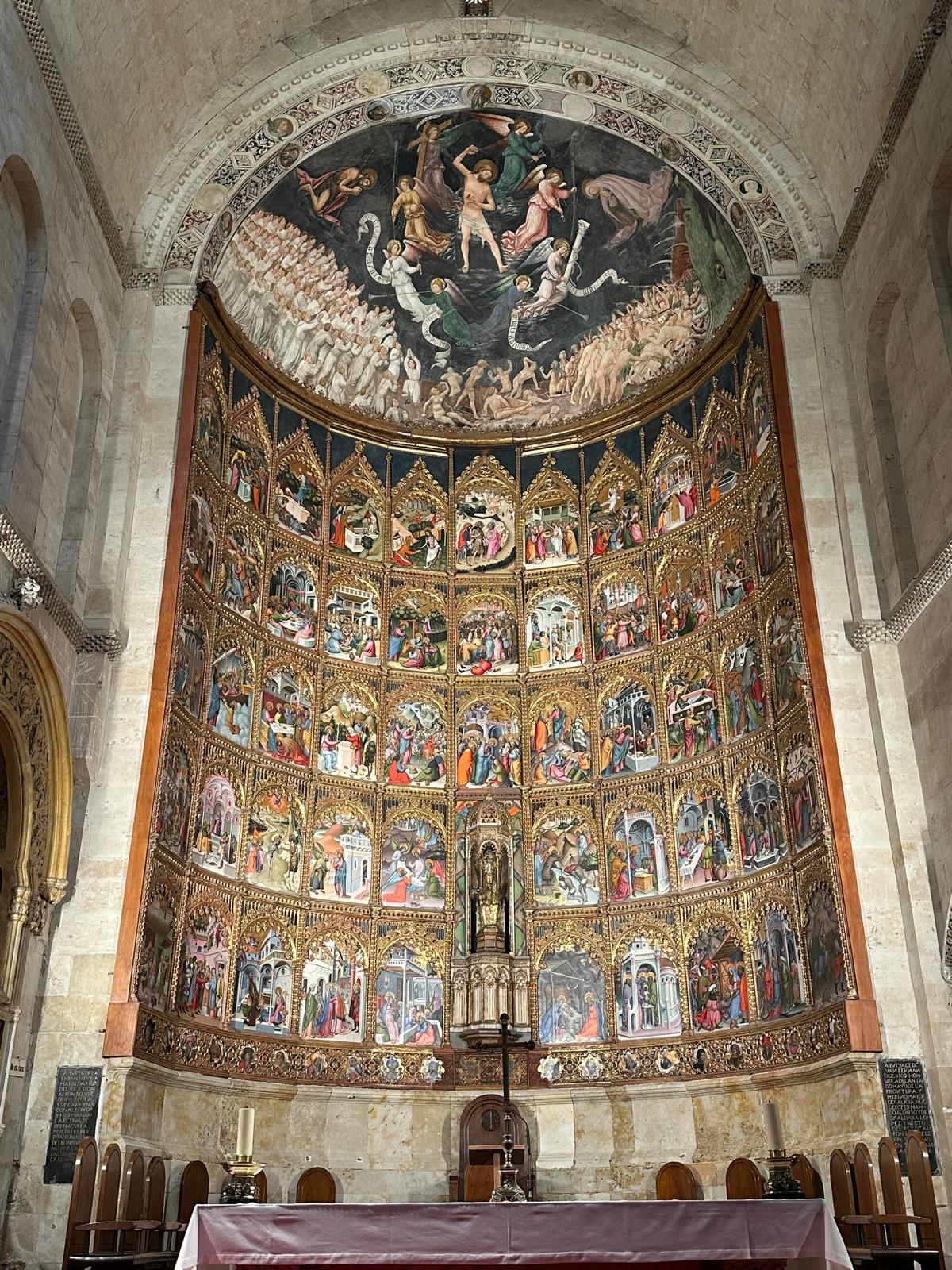
The Old Cathedral was begun in the 12th century, while the much larger New Cathedral was begun in the 16th century.
Normally, constructing a grand new cathedral meant demolishing its medieval predecessor.
Salamanca kept both.
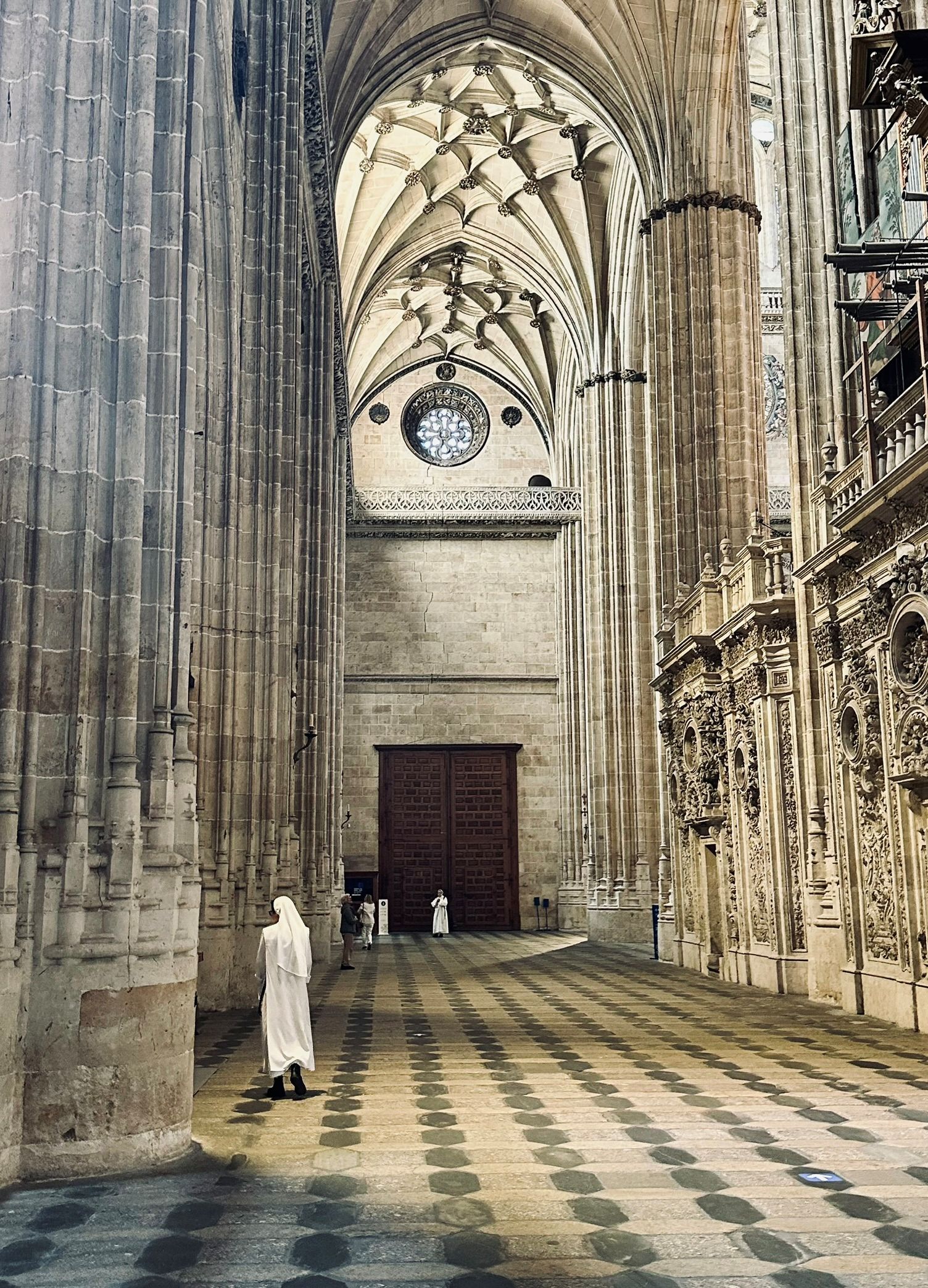
The result is an extraordinary architectural complex where Romanesque, Gothic, Renaissance and Baroque elements sit beside one another.
Inside the Old Cathedral, look for the beautiful Romanesque-Gothic dome known as the Torre del Gallo.
The New Cathedral is monumental by comparison.
But before going inside, spend a few minutes examining its elaborate entrance.
Among the carvings you'll find something decidedly unexpected:
an astronaut.
No, medieval sculptors did not predict the space programme.
The figure was added during restoration work in 1992, continuing a long tradition in which restorers sometimes incorporate details from their own period.
Look carefully and there are other curious carvings to discover too.
Don't Miss Ieronimus
One of Salamanca's best experiences isn't at ground level at all.
Ieronimus allows you to climb through the cathedral towers and upper galleries.
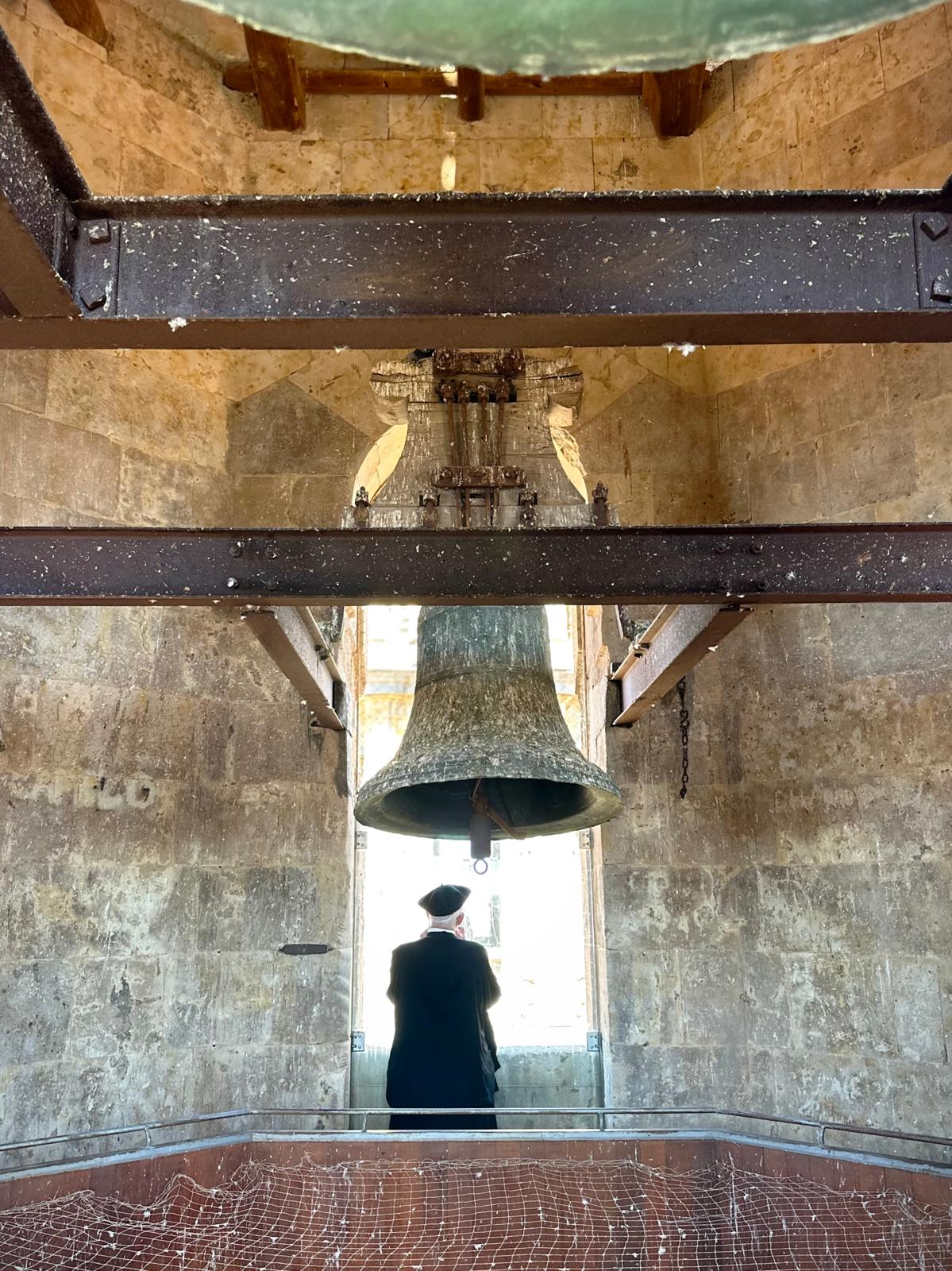
You pass above the cathedral interior, look down into the nave and eventually emerge high above Salamanca's rooftops.
The views are superb, but what makes the experience particularly memorable is being able to explore the cathedral from an entirely different perspective.
Opening hours vary through the year and capacity can be controlled, so check the current timetable and consider booking ahead.
If you only pay for one elevated viewpoint in Salamanca, we'd choose this.
A Hidden Salamanca: Convento de las Dueñas
Now walk away from the cathedral towards one of our favourite places in the city.
The Convento de las Dueñas is easy to overlook.
Don't.
Dominican nuns have lived here since the early 15th century. The convent was founded in 1419, initially occupying a Mudéjar palace before later additions transformed the complex.
Step through the relatively restrained exterior and you discover something quite unexpected.
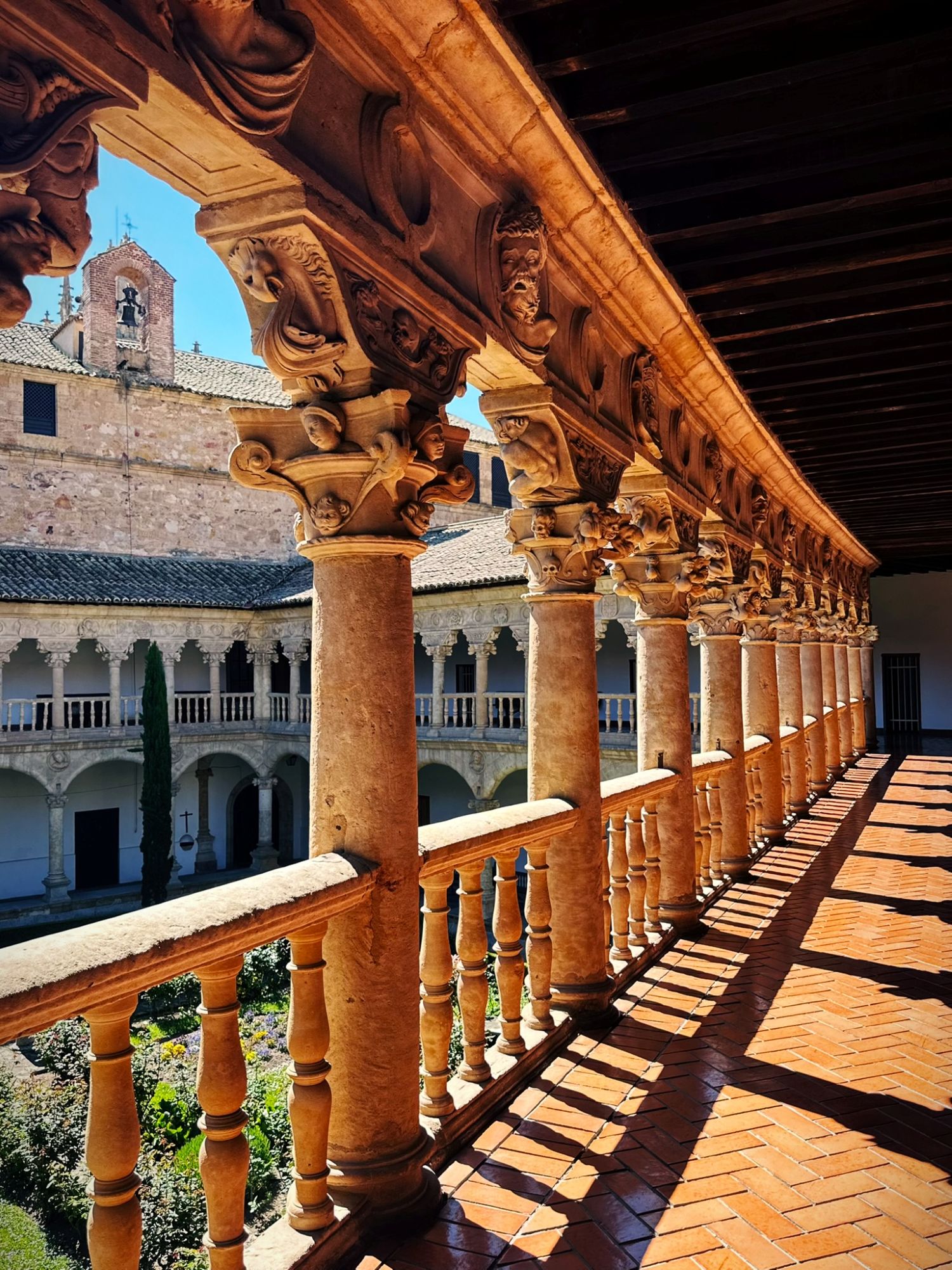
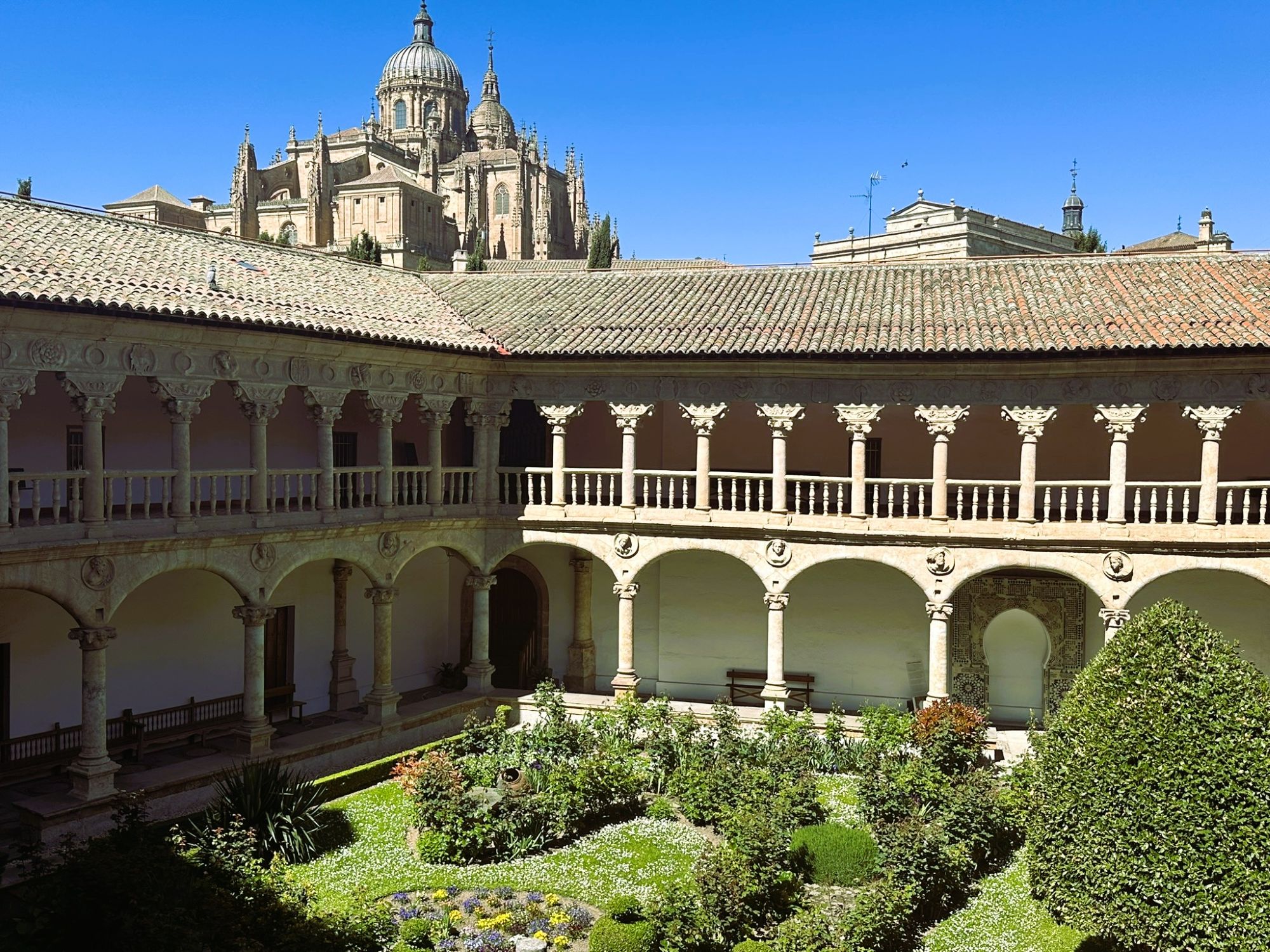
At its heart is an exquisite Renaissance cloister.
It isn't even conventionally square.
Because the builders had to work around the earlier buildings, the 16th-century cloister developed an unusual irregular five-sided plan.
Look closely at the capitals and stonework and you'll find an extraordinary collection of foliage, human figures, fantastic creatures and grotesques.
Yet what makes Las Dueñas memorable isn't simply the architecture.
It's the atmosphere.
Compared with Salamanca's university and cathedral, the cloister can feel extraordinarily peaceful.
Walk slowly around both levels.
Look through the arches towards the cathedral.
And before you leave, buy some cakes.
Cakes from the Nuns
The Dominican sisters at Las Dueñas still maintain their own bakery.
Their amarguillos, made from almond, sugar and egg white, are particularly associated with the convent, alongside biscuits, mantecados, polvorones and other traditional sweets.
The sisters make them in small batches and sell them directly at the convent.
It is exactly the sort of small experience that can become more memorable than another major monument.
You leave a Renaissance convent carrying a box of cakes baked by the nuns who live there.
There aren't many better Salamanca souvenirs.
Check opening times before visiting, particularly at weekends: Las Dueñas remains a functioning convent rather than simply a tourist attraction.
Huerto de Calixto y Melibea
Before heading down towards the river, make one more small detour.
The Huerto de Calixto y Melibea is a little walled garden associated with the lovers in La Celestina, the late-15th-century work traditionally attributed to Fernando de Rojas.
The garden isn't an archaeological recreation of somewhere mentioned in the book.
Think of it instead as a literary homage.
Its south-facing terraces are filled with plants and overlook the old city walls and the Tormes valley.
It's free, quiet and particularly lovely in late afternoon.
Then keep walking downhill.
Cross the Roman Bridge
Salamanca's Roman Bridge has carried travellers across the River Tormes for centuries.
It formed part of the Vía de la Plata, the great Roman route connecting Mérida with Astorga. Of its 26 arches, the 15 closest to the city preserve Roman origins; other sections were rebuilt following flood damage.
Walk all the way across.
Then turn around.
This is one of the best views of Salamanca.
The river fills the foreground while the cathedral towers rise above the honey-coloured city.
If you can time your visit for late afternoon, do.
The stone catches the lowering sun and you begin to understand why Salamanca has long been known as La Dorada — the Golden City.
Why You Should Stay the Night
Now you'll understand why we don't recommend rushing back to Madrid.
Walk slowly uphill again as the light fades.
Have a drink.
Change for dinner.
Then return to Plaza Mayor.
At night the square is illuminated, the cafés fill and Salamanca becomes a different city from the one you saw this morning.
Students gather beneath the arcades.
Families take their evening paseo.
Tables stay occupied late into the evening.
There is nowhere you particularly need to go.
That's the point.
Where to Eat in Salamanca
For a memorable dinner, Salamanca has some excellent contemporary restaurants alongside its traditional tapas scene.
En la Parra @enlaparra.restaurante, led by chef Rocío Parra, takes ingredients and traditions from the region and reinterprets them through contemporary cooking.
Víctor Gutiérrez @restaurant.vg offers something completely different, bringing together Spanish and Peruvian influences.
Both are excellent choices if you want to make your one night in Salamanca into a special dinner.
For something more relaxed, La Tahona Delicatessen @latahonasalama is a useful place to know for breakfast and Salamanca's traditional hornazo.
And for a drink later in the evening, try The Doctor @thedoctorcocktail.
But don't feel you need a destination restaurant for every meal.
Part of the pleasure of Salamanca is wandering around the streets off Plaza Mayor and stopping for tapas where the evening takes you.
Where to Stay in Salamanca
Our first choice for this particular trip would be Hospes Palacio de San Esteban @hospeshotelsalamanca.
Its location is excellent for this itinerary, close to Las Dueñas, San Esteban, the cathedrals and the river.
More importantly, it occupies part of the historic Dominican complex around San Esteban, so the accommodation feels connected to the city rather than simply somewhere to sleep.
Its restaurant, El Monje, occupies the former Dominican refectory and serves contemporary interpretations of Castilian and charra cooking.
For something smaller and quieter, Hotel Rector is an intimate boutique hotel just below the cathedral and close to the Roman Bridge.
It is particularly well positioned if you want to experience the historic centre before and after the day visitors arrive.
Day 2: Salamanca Beyond the Essentials
Wake early.
One of the great advantages of staying overnight is having the old city before many visitors arrive.
Walk through Plaza Mayor again and have breakfast before heading to the Convento de San Esteban.
If Las Dueñas is intimate and delicate, San Esteban is monumental.
Its great Plateresque façade rises like an enormous stone altarpiece.
The Dominican convent became associated with some of the most influential thinkers of 16th-century Spain, particularly the School of Salamanca, whose theologians and jurists wrestled with questions of natural law, economics, sovereignty and the rights of indigenous peoples at precisely the moment Spain's empire was expanding across the Atlantic.
It is an important reminder that Salamanca's university history isn't simply about old classrooms.
Ideas developed here travelled around the world.
One More Hidden Corner
If you have time, climb the Scala Coeli towers at La Clerecía for another perspective across the rooftops.
Or simply allow yourself to wander.
Salamanca rewards looking up.
Balconies, carved coats of arms, stone shells and tiny sculptural details appear everywhere.
This isn't a city where you need another ten attractions to fill the morning.
Sometimes an hour without an itinerary is more valuable.
Lunch Before the Train
Have a leisurely lunch before returning to Madrid.
If you didn't try hornazo yesterday, now is your chance.
And if you're travelling home with a box of almond cakes from Las Dueñas tucked into your luggage, even better.
There's luggage storage at Salamanca's official Visitor Reception Centre in the historic centre, useful if you've checked out but don't want to carry bags while sightseeing. Opening hours vary, so check them before relying on it.
Then head back to Salamanca station for the train to Madrid.
Less than 48 hours after leaving the capital, you'll have experienced somewhere that feels remarkably removed from it.
Can You Visit Salamanca as a Day Trip?
Absolutely.
If one day is all you have, take the earliest practical fast train from Madrid and concentrate on:
Plaza Mayor → University → Casa de las Conchas → Cathedrals → Convento de las Dueñas → Roman Bridge.
Have lunch somewhere informal and return to Madrid in the evening.
It works.
But you'll miss Salamanca after dark.
And that's why we'd stay.
Where to Stay in Madrid
If Salamanca forms part of a longer Madrid trip, don't make the mistake of staying beside Chamartín simply because that's where your train departs.
Madrid's transport system makes the station easy to reach.
For somewhere with much more atmosphere, Only YOU Boutique Hotel Madrid @onlyyouhotels is a stylish option in Chueca, within easy reach of the historic centre, Retiro and Madrid's restaurants and nightlife.
Another option is to stay around Atocha, Retiro or Barrio de las Letras, particularly if Madrid is also the starting point for other rail journeys during your trip.
Just allow plenty of time to reach Madrid Chamartín-Clara Campoamor on the morning of your Salamanca train.
Booking the Journey
This is one of the simplest independent rail trips you can make from Madrid.
You need just two long-distance tickets:
Madrid Chamartín → Salamanca
Salamanca → Madrid Chamartín
Book directly with Renfe:
Always check the journey time before buying because different train types can take significantly different amounts of time.
Once you're in Salamanca, you don't need another train.
You barely need public transport.
Almost everything in this itinerary can be reached on foot.
Which is exactly what makes Salamanca such a satisfying addition to a Madrid trip.
The Perfect Overnight Escape from Madrid
Salamanca isn't a destination built around one blockbuster attraction.
It's the combination that makes it special.
A university founded more than 800 years ago.
A tiny frog hidden in one of Spain's most elaborate façades.
Two cathedrals joined together.
An astronaut carved into Gothic-looking stone.
A five-sided Renaissance convent cloister.
Cakes made by Dominican nuns.
A Roman bridge across the Tormes.
And an illuminated Baroque square filled with people long after the day's sightseeing has finished.
You could see the highlights and be back in Madrid by bedtime.
But travel isn't always improved by doing things faster.
Stay the night.
Explore More of Spain by Train
Salamanca is just one of the journeys that becomes possible once you start treating Madrid as a railway hub rather than a single destination.
High-speed and regional trains open up extraordinary parts of Spain without needing a car — from the historic cities of Castilla y León to Andalucía, Valencia, Catalonia, Galicia and the Basque Country.
Our Touring Spain by Train guide brings those journeys together, with easy rail itineraries, practical advice and the information you need to explore Spain independently.
Discover Touring Spain by Train: