
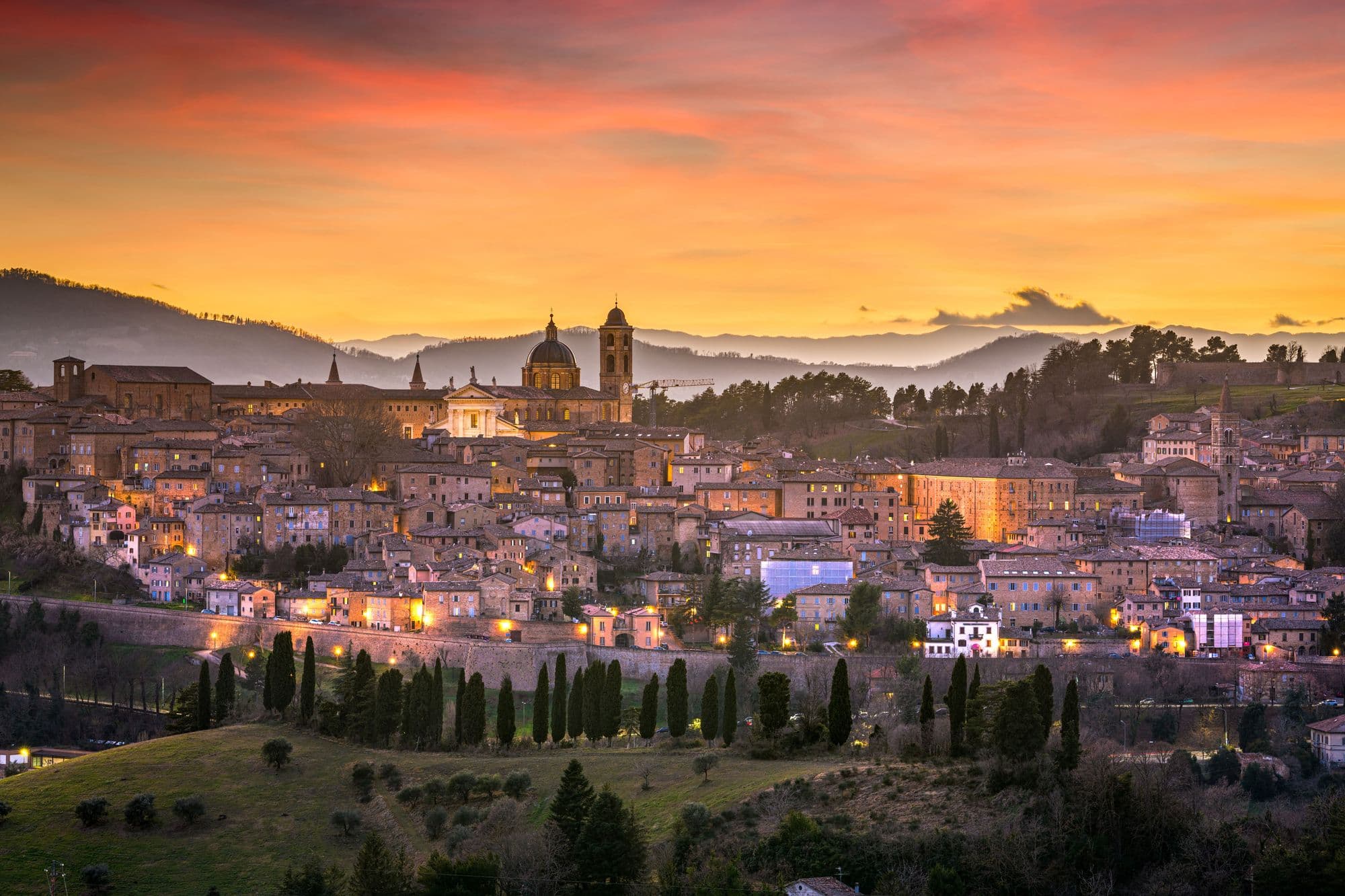
Le Marche is Italy’s quiet masterpiece — and Urbino is its jewel.
While less famous than Tuscany, this region offers rolling hills, Renaissance art, Adriatic coastline and extraordinary food — all reachable by train & bus.
Why Urbino?
If Florence was the Renaissance superstar, Urbino was its intellectual salon — smaller, quieter, but arguably more refined.
Perched dramatically in the rolling Montefeltro hills of Italy’s Le Marche region, Urbino feels less like a tourist destination and more like a preserved idea — a city deliberately designed around humanism, balance and beauty.
And that’s exactly what makes it extraordinary.
A Renaissance Court Unlike Any Other
In the 15th century, Urbino became one of the most sophisticated courts in Europe under the rule of Federico da Montefeltro, Duke of Urbino.
Federico wasn’t just a military leader — he was a humanist ruler obsessed with learning, art, architecture and philosophy. He transformed this small hill town into a Renaissance powerhouse by inviting artists, architects, writers and mathematicians to his court.
Unlike Florence — driven by merchant wealth — Urbino’s Renaissance was curated. Intentional. Almost experimental.
The result? A city that feels unified and harmonious in a way few Italian towns do.
The Palazzo Ducale: The “Ideal City”
The Palazzo Ducale isn’t just a palace — it’s one of the most important Renaissance buildings in Europe.
Designed by Luciano Laurana and later Francesco di Giorgio Martini, the palace was conceived as a “city within a city.” It blends fortress architecture with elegant classical symmetry.
Inside you’ll find:
The Duke’s intimate studiolo — an extraordinary room of illusionistic wood inlay (intarsia), depicting books, armor and instruments in 3D perspective
The Galleria Nazionale delle Marche, housing works by Piero della Francesca and Raphael
Open loggias with views across the hills that feel almost cinematic
What makes it special isn’t just the art — it’s the scale. You can absorb it fully in a morning without battling tour groups.
Birthplace of Raphael
Urbino gave the world Raphael (Raffaello Sanzio) in 1483.
His childhood home still stands in town — modest and intimate — offering a glimpse into the artistic atmosphere that shaped him.
You can stand in the room where he likely learned to draw, long before painting the Vatican Rooms in Rome.
Unlike Florence or Rome, here Raphael feels local. Personal.
A Perfectly Preserved Urban Plan
Urbino is a UNESCO World Heritage Site not because of one building — but because the entire historic centre represents a masterpiece of Renaissance urban planning.
The city was designed to reflect the ideals of harmony and proportion. Streets curve with the natural hills. Buildings maintain visual balance. Nothing feels accidental.
Even the steepness — and it is steep — contributes to the drama.
Walking here feels like stepping into a painting of an “Ideal City,” a concept deeply rooted in Renaissance philosophy.
A University City with Intellectual Energy
Founded in 1506, the University of Urbino keeps the city young and lively.
This isn’t a frozen museum town. It’s a place where students debate philosophy in cafés, where Renaissance architecture frames modern life.
That blend — ancient stone and youthful energy — gives Urbino a pulse many hill towns lack.
The Landscape: The Montefeltro Hills
The surrounding landscape is part of the experience.
Soft green ridges ripple outward in every direction — less manicured than Tuscany, more rugged, more authentic. The light here is extraordinary, especially late afternoon when the hills turn golden.
It’s easy to see why Renaissance painters obsessed over perspective — this landscape practically teaches it.
Unique Cultural Touches
A few things that make Urbino quietly special:
Crescia sfogliata – a flaky, layered flatbread unique to this region
White truffles in autumn
Verdicchio wine from nearby vineyards
Ceramic craftsmanship traditions
Deep ties to Renaissance humanist philosophy
This isn’t just sightseeing. It’s immersion in a place that helped shape European thought.
Day 1: Renaissance Urbino
Palazzo Ducale
Masterpiece of Renaissance architecture.See Raphael’s works in the Galleria Nazionale delle Marche.
Urbino Cathedral
Neoclassical interior, peaceful atmosphere.
Wander the Streets
Steep lanes, artisan shops, student energy (it’s a university town).
Dinner
Try:
Crescia sfogliata (local flatbread)
Truffle pasta
Verdicchio wine
Day 2: Countryside & Adriatic
Option 1: Bus to Pesaro – Adriatic beach walk
Option 2: Explore nearby hill towns
Option 3: Rent e-bikes for countryside riding
Hidden gem: Montefeltro landscapes at sunset.
Why Base Yourself Here?
Unlike Florence or Siena, Urbino feels authentic and uncrowded. You can immerse yourself in Renaissance Italy without tour groups.
Ideal 3-Day Structure
Day 1 – Urbino culture
Day 2 – Countryside or coast
Day 3 – Gradara or Pesaro excursion
Le Marche rewards slow travelers. And with smart rail & bus connections, you don't need a car.
Getting to Urbino from Major Airports
Urbino does not have its own train station, but it’s easily reached via Pesaro.
From Rome Fiumicino Airport
Leonardo Express to Roma Termini (32 mins)
Frecciarossa or Intercity to Pesaro (approx. 3 hours)
Bus from Pesaro station to Urbino (1 hour, frequent connections)
Total journey: approx. 4.5–5 hours
From Bologna Airport
Marconi Express to Bologna Centrale
Train to Pesaro (1.5–2 hours)
Bus to Urbino
Total journey: approx. 3 hours
From Ancona Airport
Taxi or bus to Ancona station, Train to Pesaro (1 hour), Bus to Urbino