
Discovering Cádiz by Train: Spain's Ancient Atlantic City
How to explore one of Europe's oldest cities by train, from hidden masterpieces and Phoenician history to Atlantic beaches, boat trips and unforgettable seafood.
The train seems almost to glide across the sea. For the final few kilometres before Cádiz, water stretches away on both sides of the tracks. To one side lies the broad Bay of Cádiz, calm and dotted with fishing boats. On the other, the Atlantic rolls towards long sandy beaches that have protected this city for more than three thousand years. The railway follows a narrow strip of land before finally arriving at the end of the line, where Spain simply gives way to the ocean.
Within minutes of stepping off the train, you're standing beneath palm trees in the heart of one of Europe's oldest cities.
There is no airport shuttle to navigate, no expensive taxi ride and no need to hire a car. Cádiz railway station sits beside the port and just outside the historic centre, allowing you to begin exploring almost immediately. It is one of those wonderfully rare cities where arriving by train feels like part of the experience rather than simply a means of getting there.
Yet remarkably few visitors stay long enough to understand it.
Many arrive from Seville for a few hours, wander through the cathedral, photograph La Caleta beach, eat a plate of fried fish and return on the evening train. Cádiz certainly lends itself to a day trip, but doing so means missing the quiet moments that reveal its real character: the market coming alive with fishermen and chefs before lunch, elderly neighbours chatting beneath shaded balconies in La Viña, the golden light washing across Campo del Sur as the Atlantic breeze begins to cool the city, or the cathedral dome glowing above the rooftops as church bells echo through the narrow streets.
Slow down and Cádiz becomes something altogether different.
This is not simply another attractive Andalusian city. It is the ancient Phoenician settlement of Gadir, founded around 1100 BC and widely regarded as the oldest continuously inhabited city in Western Europe. It became the prosperous Roman port of Gades, flourished during Spain's trade with the Americas, witnessed the birth of Spain's first liberal constitution and today remains a city whose identity is inseparable from the sea.
Its history can be discovered not only in famous monuments but in hidden Roman ruins beneath medieval streets, merchant watchtowers rising above elegant houses, remarkable paintings by El Greco and Zurbarán tucked away inside quiet buildings, and neighbourhoods where carnival songs remain part of everyday life.
Better still, almost everything can be reached on foot.
Spend three or four days here and you'll quickly understand why Cádiz is one of Spain's most rewarding destinations for independent travellers. Arrive by train, explore at your own pace, cross the bay by boat, return by rail and experience a city that has always looked outward towards the Atlantic.
Getting to Cádiz by Train
Few Spanish cities are as easy to reach by rail.
Cádiz sits at the southern end of one of Andalusia's principal railway lines, making it straightforward to include within a wider itinerary through southern Spain. Whether you're travelling from Madrid, Seville or elsewhere in Andalusia, the journey itself provides an introduction to the landscapes that have shaped this corner of the country.
From Seville
For most visitors, Seville provides the natural gateway.
Frequent regional and Media Distancia services connect Sevilla Santa Justa with Cádiz throughout the day, with journey times generally taking around one hour and forty minutes. The route passes through fertile countryside before reaching the vineyards and sherry country around Jerez de la Frontera, then continues through marshes and coastal towns before finally crossing onto the narrow peninsula leading into Cádiz.
Watch carefully during the final approach.
The railway runs across the low-lying landscape of the Bay of Cádiz before water suddenly appears on both sides of the train. It is one of Spain's most memorable railway arrivals and a reminder that Cádiz has always been a city defined by its relationship with the sea.
From Madrid
Direct high-speed and long-distance services link Madrid Puerta de Atocha-Almudena Grandes with Cádiz several times each day.
The journey takes around four and a half hours, carrying passengers from the plains of central Spain through Córdoba and Seville before continuing into western Andalusia.
Although flying may initially seem quicker, the train often proves the more relaxing option. City-centre to city-centre travel eliminates airport transfers and lengthy security queues, allowing you to step directly from Madrid into the heart of Cádiz without changing transport.
From Córdoba
Travelling from Córdoba is equally straightforward.
Several direct services operate each day, while others require an easy change at Seville. Journey times are generally around three hours, making Cádiz an excellent extension to an Andalusian itinerary that includes Granada, Córdoba and Seville.
From Málaga and Granada
Reaching Cádiz from Málaga or Granada requires a little more planning, but remains entirely practical by rail.
Most journeys involve changing at Córdoba or Seville, depending on the timetable. Although the journey takes longer than the distance on a map might suggest, it offers an opportunity to experience more of Andalusia's rail network rather than relying on a car.
If you're touring southern Spain by train, Cádiz works particularly well as your final destination before returning north.
Why Cádiz Is Perfect Without a Car
Many Spanish cities can be visited without driving.
Few make it feel quite so unnecessary.
The historic centre occupies a compact peninsula little more than a kilometre across. From Cádiz railway station, it takes barely ten minutes to reach the cathedral, around fifteen minutes to the bustling Mercado Central and less than half an hour to La Caleta beach.
Most of the city's greatest attractions lie within comfortable walking distance of one another.
The streets are largely flat, navigation is simple and there is rarely any need to think about transport once you've arrived. Instead of worrying about parking or traffic restrictions, you spend your time wandering narrow lanes, stopping for coffee in shaded squares and discovering small churches, hidden courtyards and family-run taverns that rarely appear in guidebooks.
When you do wish to explore further, local transport fits perfectly into a slow-travel itinerary.
Cercanías trains connect Cádiz with nearby coastal towns, public catamarans cross the bay to El Puerto de Santa María and Rota, while buses and the Trambahía system provide access to surrounding communities.
The result is a city that rewards exactly the kind of independent, car-free travel that rail enthusiasts love.

Three Thousand Years Beside the Atlantic
Standing on Cádiz's sea walls today, it is difficult not to imagine the countless ships that have approached this peninsula over the centuries.
Long before Spain existed, long before the Roman Empire and even before classical Greece reached its height, Phoenician sailors from the eastern Mediterranean recognised the strategic value of this remarkable location.
Around 1100 BC, they established a trading settlement known as Gadir.
Its position was ideal.
Protected natural harbours faced both the Atlantic Ocean and the sheltered waters of the bay, while rich mineral resources lay inland across southern Iberia. Phoenician merchants traded silver, copper and tin throughout the Mediterranean, helping transform Gadir into one of the western world's earliest commercial ports.
Although little survives above ground from this earliest settlement, archaeological discoveries continue to reveal its importance.
The magnificent Phoenician sarcophagi displayed today in the Museum of Cádiz remain among the finest surviving examples of Phoenician funerary sculpture anywhere in the world.
When Rome absorbed southern Iberia, Gadir became Gades, one of Hispania's wealthiest cities.
Roman merchants expanded the harbour, exporting salted fish and the famous fermented fish sauce known as garum throughout the empire. Julius Caesar himself is believed to have spent time here, while the city's prosperity financed monumental public buildings, including an enormous theatre capable of seating around 20,000 spectators.
For centuries, much of this Roman city disappeared beneath later construction.
Only in 1980, during building work behind the cathedral, did archaeologists unexpectedly rediscover the theatre beneath layers of medieval houses. Today visitors can walk through its remains, revealing just how important Roman Gades once was.
Following the Roman period came Visigothic and later Islamic rule before Cádiz was captured by Alfonso X during the Reconquista in the thirteenth century.
Yet the city's greatest period of prosperity still lay ahead.
Gateway to the New World
The discovery of the Americas transformed Cádiz forever.
Initially, Spain's colonial trade was controlled from Seville, whose inland position on the Guadalquivir River offered protection from attack. But as ships grew larger and trade expanded, navigating upriver became increasingly difficult.
In 1717, Spain transferred the Casa de Contratación—the institution responsible for regulating commerce with the Americas—from Seville to Cádiz.
The effect was dramatic.
Merchant ships arrived laden with silver, spices, tobacco, cocoa and exotic goods from across the Atlantic. Wealth flooded into the city, financing elegant mansions, churches and public buildings that still define much of Cádiz today.
Look upwards as you wander through the old town and you'll notice one of Cádiz's most distinctive architectural features.
Dozens of merchant houses are crowned with elegant watchtowers.
These were not ornamental.
From these elevated vantage points, wealthy merchants scanned the horizon for ships returning from the Americas, eager to learn which vessels had safely reached port and which fortunes had arrived with them.
More than one hundred of these towers survive, giving Cádiz a skyline unlike any other city in Spain.
A City That Helped Shape Modern Spain
Cádiz also occupies a unique place in Spanish political history.
During the Napoleonic Wars, much of Spain fell under French occupation. Cádiz, protected by its fortifications and the Royal Navy's control of the surrounding waters, resisted successfully and became one of the few major Spanish cities never captured by Napoleon's forces.
Representatives from across Spain gathered here to debate the country's future.
The result was the Constitution of 1812, affectionately known as La Pepa because it was proclaimed on the feast day of Saint Joseph.
It introduced ideas that were revolutionary for its time: national sovereignty, representative government and limits on royal power. Although its influence was repeatedly interrupted by political upheaval, the constitution became a landmark in Spain's constitutional development and inspired liberal movements across Europe and Latin America.
Walking through Cádiz today, it is easy to forget that these quiet streets once stood at the centre of events that shaped an entire nation.
El Pópulo: Where Cádiz Began
The best place to begin exploring is El Pópulo, the oldest neighbourhood in the city.
Pass beneath one of its medieval gateways and modern Cádiz seems to disappear.
The streets narrow dramatically, twisting between weathered stone buildings whose foundations conceal layers of Roman and medieval history. Small balconies overflow with flowers, laundry hangs above cobbled lanes and tiny squares appear unexpectedly around almost every corner.
Unlike some historic quarters that have become dominated by souvenir shops, El Pópulo still feels lived in.
Neighbours chat from open doorways, local cafés serve morning coffee to residents rather than tour groups, and children still play beneath buildings that have stood here for centuries.
Come early.
By nine o'clock the streets remain remarkably peaceful, allowing you to appreciate details that many visitors miss: carved stone doorways, fragments of ancient walls and the subtle changes in architecture marking each period of Cádiz's remarkable history.
This is the Cádiz that rewards wandering without a map.
The Roman Theatre
Hidden behind the cathedral lies one of Spain's most important archaeological discoveries.
The Roman Theatre of Gades remained forgotten beneath the city for centuries until workers unexpectedly uncovered it during construction work in 1980.
The discovery astonished archaeologists.
Built during the first century BC, the theatre ranks among the largest in the entire Roman Empire, capable of accommodating around 20,000 spectators. Its sheer scale reflects the wealth and importance of Roman Gades, whose prosperity rested on trade and the production of fish products exported across the Mediterranean.
Today visitors enter through an interpretation centre before walking into the excavated remains themselves.
Although only part of the theatre has been uncovered, standing among the ancient stone seating while medieval houses rise directly above provides a powerful reminder that Cádiz has continually rebuilt itself over more than three millennia.
Few places illustrate the city's extraordinary layers of history so vividly.
Cádiz Cathedral
Emerging from El Pópulo, the city suddenly opens onto one of Andalusia's most striking cathedral squares.
Construction of Cádiz Cathedral began in 1722 during the city's commercial golden age and continued for more than a century. Unsurprisingly, its architecture reflects this unusually long building period.
The lower sections display the exuberance of the Baroque, while later work adopted the cleaner lines of Neoclassicism. Above everything rises the cathedral's distinctive golden dome, which catches the Atlantic sunlight throughout the day and has become one of Cádiz's defining landmarks.
The interior is impressive, but don't miss the climb up the cathedral tower.
From above, Cádiz's remarkable geography becomes immediately apparent.
Whitewashed rooftops stretch across the narrow peninsula, punctuated by church domes and merchant watchtowers, while the Atlantic surrounds the city on almost every side.
It is the perfect introduction to understanding why Cádiz has always belonged as much to the sea as to the land.
Torre Tavira: Watching for the New World
If Cádiz has one building that perfectly captures its relationship with the sea, it is Torre Tavira.
Rising above the rooftops near the centre of the old town, the tower was the official watchtower of Cádiz during the eighteenth century, when fortunes depended upon ships returning safely from the Americas. From here, the city's official lookout scanned the horizon for merchant vessels approaching the harbour, relaying news of arriving cargoes to anxious merchants waiting below.
Today, climbing the tower offers one of the finest panoramic views in Andalucía.
From the roof, the entire geography of Cádiz unfolds before you. The cathedral's golden dome gleams above a maze of whitewashed streets, the Atlantic crashes against the western shore, while the calm waters of the bay stretch away towards El Puerto de Santa María and Puerto Real. Looking across the rooftops, you'll also notice dozens of smaller towers punctuating the skyline.
These merchant watchtowers are unique to Cádiz.
During the city's commercial heyday, wealthy merchants built elegant towers above their homes so they could watch for their own ships returning from the New World. More than 120 still survive, creating a skyline unlike anywhere else in Spain and serving as a reminder that Cádiz was once one of Europe's great trading ports.
Inside Torre Tavira is another fascinating curiosity: the Camera Obscura.
Using mirrors and lenses, a live image of Cádiz is projected onto a large white table, allowing guides to zoom in on people walking through distant streets, fishing boats entering the harbour and life unfolding across the city in real time. It may sound surprisingly simple, but the effect remains genuinely captivating and offers an entirely different perspective on Cádiz.

A Hidden Masterpiece: El Greco at the Women's Hospital
One of Cádiz's greatest artistic treasures is also one of its least visited.
Tucked away on a quiet street a few minutes from Torre Tavira stands the Hospital de Mujeres, or Women's Hospital, founded during the eighteenth century to care for poor women in the city. From outside, it appears to be simply another elegant historic building, its understated façade giving little hint of what lies within.
Step through the entrance into the peaceful courtyard and everything slows.
Arcaded galleries surround a tranquil central patio where the bustle of Cádiz seems to disappear completely. Beyond the courtyard sits the small Baroque chapel, and inside hangs one of Spain's great paintings.
El Greco's St Francis's Vision of the Flaming Torch.
Painted during the final years of the artist's life, the work depicts Saint Francis absorbed in mystical contemplation as a supernatural flame appears before him. The saint's elongated figure, dramatic gestures and intensely expressive face are unmistakably El Greco. Dark storm clouds swirl behind him while brilliant shafts of light illuminate his robes, creating the spiritual tension that made the painter one of the most original artists of the Spanish Renaissance.
Unlike seeing an El Greco in the Prado Museum, here you encounter the painting almost alone.
There are no crowds pressing forward, no security barriers keeping you several metres away. Instead, the painting remains in an intimate chapel where visitors can appreciate every brushstroke in remarkable tranquillity. It feels less like viewing a museum exhibit and more like discovering a secret that Cádiz has quietly kept for centuries.
It is exactly the sort of hidden experience that rewards those who spend more than a few hurried hours in the city.
Opening hours can be limited and occasionally vary, so it's worth checking locally before your visit. If the chapel is open, don't hesitate—it is one of the finest artistic experiences in Cádiz.

The Museum of Cádiz: Phoenicians, Romans and Zurbarán
If the Women's Hospital introduces Cádiz's artistic heritage, the Museum of Cádiz explains the city's extraordinary story.
Occupying a handsome nineteenth-century building overlooking leafy Plaza de Mina, the museum combines archaeology and fine art in a way that perfectly reflects Cádiz itself.
Begin downstairs.
The archaeological galleries tell the story of Gadir, the Phoenician city that grew into Roman Gades. Among the highlights are the museum's famous Phoenician sarcophagi, discovered by chance in the nineteenth century during construction work outside the city walls.
Carved from marble with astonishing realism, the anthropoid coffins depict an unknown man and woman whose serene expressions seem almost startlingly modern. Their craftsmanship reflects the remarkable artistic sophistication of the Phoenicians and serves as tangible evidence of Cádiz's role within an international trading network stretching from the eastern Mediterranean to the Atlantic coast.
Nearby, Roman sculptures, ceramics, jewellery and everyday objects continue the story through the city's imperial period, helping visitors understand why Gades became one of Hispania's wealthiest ports.
But don't leave after the archaeology.
Upstairs awaits one of Andalucía's finest collections of Spanish Golden Age painting.
Zurbarán's Quiet Genius
The museum possesses an exceptional collection of works by Francisco de Zurbarán, one of the greatest painters of seventeenth-century Spain.
While Velázquez painted kings and Murillo became known for softer religious scenes, Zurbarán specialised in something altogether quieter.
His saints, monks and religious figures possess an extraordinary stillness.
Draped in luminous white robes against deep black backgrounds, they seem almost sculptural rather than painted. Every fold of cloth, every weathered face and every clasped hand is rendered with astonishing precision. Yet despite their realism, these paintings are deeply spiritual, encouraging contemplation rather than drama.
Many of the museum's Zurbarán works originally belonged to monasteries across Andalucía before entering the museum during the nineteenth century.
Standing before them, it's difficult not to notice the contrast with the city outside.
Only a few streets away, Cádiz buzzes with cafés, beaches and Atlantic sunshine. Inside these galleries, everything becomes hushed and contemplative. Together with El Greco's St Francis, the paintings reveal another side of Cádiz that many visitors never suspect exists.
Allow at least an hour for the museum.
It is not simply somewhere to shelter from the midday heat, but one of the best places to understand how Cádiz evolved from Phoenician trading post to wealthy imperial city.

Plaza de Mina
Stepping back outside, you'll emerge into one of Cádiz's loveliest public spaces.
Shaded by mature trees and lined with elegant nineteenth-century buildings, Plaza de Mina feels worlds away from the busy cathedral quarter. Children play beneath the trees while locals occupy benches beneath the shade, creating one of those wonderfully relaxed squares that invite you to pause rather than hurry on.
It is an ideal place for a coffee before continuing towards the market.
Mercado Central: The Flavours of the Atlantic
Every great port city has a market that reflects its relationship with the sea.
In Cádiz, that place is Mercado Central.
Long before tourists arrive, fishermen, restaurant owners and local residents gather beneath its elegant iron structure to inspect the morning's catch. Ice-covered counters display glistening tuna, prawns, sea bream, squid, octopus and species unfamiliar to many visitors from northern Europe.
This is where Cádiz's cuisine begins.
Around the outside of the market, traditional fishmongers now share space with informal food stalls serving freshly prepared dishes made from ingredients bought only a few metres away.
Order a paper cone of perfectly fried fish, try tortillitas de camarones—delicate crisp fritters packed with tiny Atlantic shrimp—or simply find a seat with a glass of chilled fino sherry while watching the rhythm of everyday life unfold around you.
Unlike markets that have become entirely tourist-focused, Mercado Central remains very much part of local life.
Come before lunch, when chefs are selecting ingredients and neighbours stop to exchange news while shopping. It offers a far more authentic glimpse of Cádiz than many of the city's monuments.
La Viña: The Soul of Cádiz
Continue west and the streets begin to change once again.
Welcome to La Viña.
Traditionally the fishermen's quarter, this remains one of Cádiz's most characterful neighbourhoods. Laundry hangs between balconies, conversations drift from open windows and small family-run bars spill onto narrow streets where locals gather late into the evening.
If El Pópulo tells the story of ancient Cádiz, La Viña reveals the modern city.
It is also the spiritual home of Carnival.
Every February, Cádiz stages one of Spain's greatest festivals, but unlike the flamboyant costumes associated with places such as Venice or Rio, Carnival here revolves around wit.
Its famous chirigotas—small musical groups performing humorous, often biting satirical songs—lampoon politicians, celebrities and everyday life with remarkable creativity. Winning performances become the soundtrack of the city for months afterwards, and even outside Carnival season you'll hear locals discussing favourite groups and memorable performances.
Carnival isn't simply an event for tourists.
It is one of the ways Cádiz understands itself.
Walking through La Viña, you'll pass rehearsal venues, neighbourhood bars filled with Carnival memorabilia and streets where many of the city's best-known performers first began singing.
Few places capture Cádiz's humour and personality quite so well.

La Caleta: Where Cádiz Meets the Atlantic
Eventually the streets open onto the Atlantic.
Nestled between the castles of Santa Catalina and San Sebastián lies La Caleta, Cádiz's most iconic beach.
It isn't the largest.
Nor is it the wildest stretch of coastline nearby.
What makes La Caleta special is its setting.
Fishing boats bob gently in the shallow bay, the elegant spa building sits above the sand, while the old city rises immediately behind. At sunset, the cathedral dome catches the last golden light as local families gather along the promenade and swimmers linger in the warm Atlantic water.
Few urban beaches in Europe feel so completely woven into the life of their city.
Come early in the morning for a peaceful swim, or return in the evening when the heat has softened and Cádiz begins its nightly paseo.
This is where the city breathes.
Campo del Sur: Cádiz's Great Atlantic Balcony
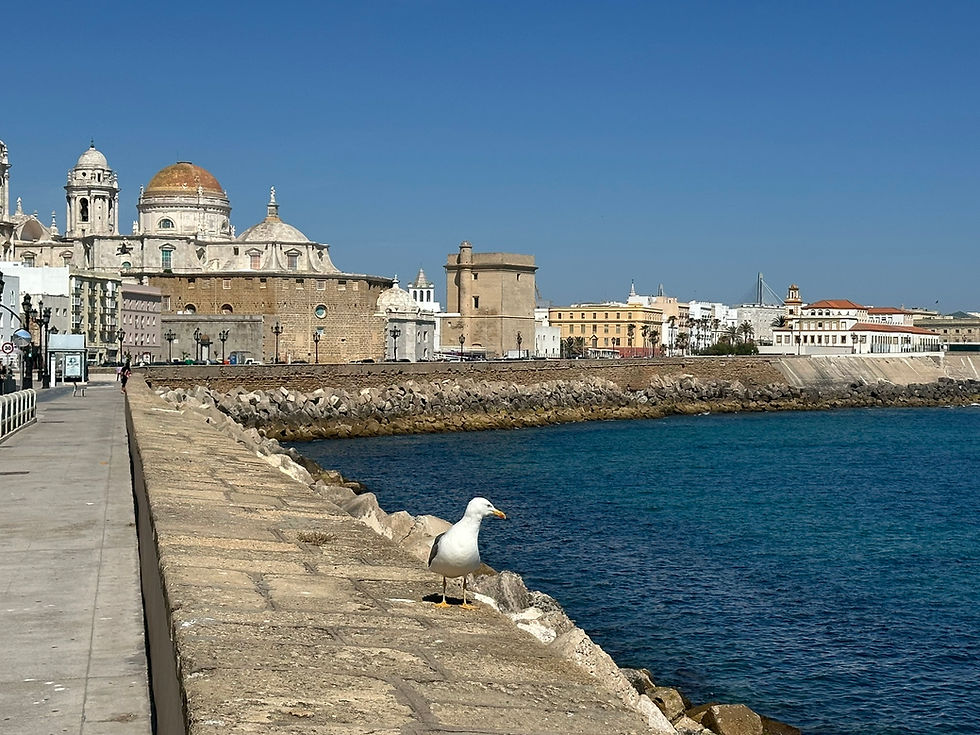
Leave La Caleta behind and follow the stone promenade that curves around the southern edge of the old city. This is Campo del Sur, one of the most spectacular waterfront walks in Spain.
The Atlantic is never far away in Cádiz, but here it feels wonderfully close. Waves crash directly against the sea wall below, sending spray high into the air on windy days, while fishing boats head out through the harbour entrance towards the open ocean. Above the promenade, rows of elegant eighteenth and nineteenth-century buildings stand shoulder to shoulder, their white façades glowing in the afternoon sunshine.
The route has been nicknamed "Little Havana" by some visitors because of its sweeping waterfront and colourful buildings, but in truth Campo del Sur feels unmistakably Andalusian. Elderly couples stroll arm in arm in the evening, runners weave between families enjoying the cooler air after sunset, and friends gather on the sea wall simply to watch the Atlantic. There is no great attraction demanding your attention here. The promenade itself is the attraction.
If you've arrived from inland Spain, Campo del Sur is where you really appreciate that Cádiz has always belonged to the sea.

The Castles That Guarded the City
For centuries, Cádiz's wealth made it a tempting target for pirates, rival navies and invading armies. The city's position on a narrow peninsula meant that whoever controlled its approaches controlled one of Europe's richest ports, so impressive fortifications were built to defend it.
Castillo de Santa Catalina
Standing beside La Caleta, Castillo de Santa Catalina was constructed after the Anglo-Dutch attack on Cádiz in 1596. Designed in the shape of a star, its thick stone walls project into the Atlantic, enclosing peaceful courtyards where cannons once stood ready to repel enemy ships.
Today the atmosphere is rather different.
Instead of soldiers, you'll find art exhibitions, cultural events and visitors wandering along the battlements. Best of all, entry is usually free, making it one of the city's most enjoyable places to explore. Walk around the outer walls and you'll be rewarded with magnificent views across La Caleta, back towards the cathedral and out across the Atlantic.
It's a wonderful place to visit late in the afternoon when the golden light softens the stone walls and the beach below begins to empty.
Castillo de San Sebastián
At the opposite end of La Caleta stands the more dramatic Castillo de San Sebastián, connected to the city by a long causeway stretching out into the Atlantic.
The walk alone is worth making.
With water on both sides and seabirds wheeling overhead, it feels as though you're leaving the city behind and heading out to sea. Local fishermen line the causeway with their rods, while photographers pause repeatedly to capture the changing perspective of Cádiz's skyline.
The present fortress dates largely from the eighteenth century, although the site has a much longer history. Tradition suggests that a temple dedicated to Kronos once stood here, making this rocky outcrop significant long before the castle itself was built.
Today visitors come less for military history than for the extraordinary setting. Looking back towards Cádiz, you'll understand why artists and filmmakers have been drawn to this stretch of coastline for decades.
Parque Genovés: Cádiz's Green Refuge
After the narrow streets of the old town, Parque Genovés feels unexpectedly lush.
Running along the northern edge of the peninsula, this elegant botanical garden was laid out during the nineteenth century and remains one of Cádiz's most beautiful public spaces. Towering ficus trees, exotic palms and carefully maintained flowerbeds create welcome shade during the warmer months, while winding paths lead visitors towards ornamental ponds, sculptures and one delightfully eccentric feature—a large artificial waterfall cascading over limestone rocks.
Children delight in feeding ducks and watching peacocks wander freely through the gardens, while locals settle onto benches beneath the trees with newspapers or books.
It's the perfect place to escape the midday heat before continuing your exploration.
Alameda Apodaca: Cádiz's Most Elegant Promenade
Just beyond Parque Genovés lies one of Cádiz's loveliest promenades.
Alameda Apodaca combines beautifully landscaped gardens with panoramic views across the Bay of Cádiz. Marble benches, ornate ceramic balustrades and carefully clipped hedges give the area an almost aristocratic feel, reflecting the prosperity Cádiz enjoyed during the eighteenth century.
Unlike the dramatic Atlantic-facing Campo del Sur, Alameda Apodaca offers calmer views across the sheltered bay. Ferries cross towards El Puerto de Santa María, cruise ships ease into the harbour and sailing boats drift across the water.
It is particularly lovely in the early evening, when locals emerge for their traditional paseo before dinner.
Playa Victoria: Cádiz's Endless Beach
Although La Caleta is undoubtedly Cádiz's most famous beach, Playa Victoria offers something entirely different.
Stretching for almost three kilometres along the Atlantic coast beyond the old town, this broad expanse of golden sand regularly appears in lists of Spain's finest urban beaches. Its size means it rarely feels crowded, even during the height of summer, while excellent facilities make it popular with local families.
A pleasant seafront promenade runs alongside the beach, lined with cafés and restaurants where it's easy to stop for a drink while watching surfers, volleyball games and evening walkers enjoying the sea breeze.
From the historic centre, Playa Victoria is easily reached by local bus or a leisurely walk if you have the time.
Crossing the Bay: El Puerto de Santa María
One of the greatest pleasures of visiting Cádiz is that your day trip can begin by boat and end by train.
Walk down to the ferry terminal beside the port and board the catamaran crossing the Bay of Cádiz to El Puerto de Santa María. The journey takes around half an hour but offers a completely different perspective of the city. As the boat pulls away, Cádiz gradually reveals its true shape—a slender peninsula surrounded almost entirely by water, crowned by the cathedral's golden dome and the merchant watchtowers that once watched for ships from the Americas.
El Puerto itself has long been associated with maritime trade and the production of sherry. Its attractive old centre is perfect for wandering, while Castillo de San Marcos, built around the remains of an earlier mosque, reflects the town's fascinating layers of history.
The town is also home to several renowned sherry bodegas where visitors can learn about one of Andalucía's most celebrated wines.
When you're ready to return, simply board one of the frequent Cercanías trains back to Cádiz. The journey takes barely twenty-five minutes, making this one of Spain's most satisfying combinations of ferry and rail travel.
Rota: Cádiz's Relaxed Coastal Neighbour
Continue around the bay and you'll reach Rota, a charming seaside town that feels worlds away from the bustle of larger resorts.
Its historic centre remains wonderfully authentic, with whitewashed streets, small squares and a handsome castle overlooking the waterfront. Long sandy beaches stretch in both directions, while waterfront restaurants specialise in fresh seafood landed only hours earlier.
Rota is an ideal destination if you want a quieter day beside the sea before returning to Cádiz in the evening.
San Fernando: Salt Marshes and Flamingos
Few visitors realise that one of Andalucía's most important natural landscapes lies only minutes from Cádiz.
The Bahía de Cádiz Natural Park, centred around San Fernando, protects an extraordinary network of tidal salt marshes that have shaped life here for centuries. Traditional salt pans still operate in places, while shallow lagoons provide habitat for flamingos, avocets, spoonbills and dozens of other bird species.
Wooden walkways cross the wetlands, offering peaceful walks quite unlike anywhere else in Andalucía.
It is a rewarding excursion for anyone interested in nature or photography and provides a fascinating contrast to Cádiz's historic centre.
Where to Stay
One of the pleasures of staying in Cádiz is that many of the city's finest hotels occupy beautifully restored historic buildings rather than anonymous modern blocks. Staying in the old town allows you to walk almost everywhere, from the cathedral and Roman Theatre to La Caleta and Mercado Central, making it the perfect base for a car-free visit.
For a stylish boutique stay, Casa Cánovas (@casacanovashotel) blends contemporary comfort with elegant eighteenth-century architecture just a few minutes from Plaza de Mina. It's an excellent choice if you want to immerse yourself in the atmosphere of the old city.
History lovers should look at Casa de las Cuatro Torres (@casa4torres), one of Cádiz's most distinctive merchant houses. Sleeping beneath one of the city's famous watchtowers offers a genuine connection to the era when merchants scanned the Atlantic for ships returning from the Americas.
If waking up to uninterrupted ocean views is more your style, the Parador de Cádiz (@paradores) combines modern design with one of the city's finest waterfront locations. Overlooking the Atlantic and within easy walking distance of La Caleta, it's hard to imagine a better place to watch the sun disappear into the ocean.
Where to Eat
Cádiz's cuisine is inseparable from the Atlantic.
Fresh tuna, prawns, shellfish and perfectly fried fish dominate menus throughout the city, often accompanied by a chilled glass of local sherry from nearby Jerez.
One restaurant that deserves a place on your itinerary is Contraseña (@contrasenacadiz). Creative without being pretentious, it takes classic Andalusian flavours and gives them a contemporary twist using exceptional local ingredients. If you've photographed your meal here, you'll already know why it has become one of Cádiz's most talked-about dining experiences.
For a true Cádiz institution, book a table at El Faro de Cádiz (@elfarodecadiz). Serving outstanding seafood for more than half a century, it's one of those restaurants where generations of local families celebrate special occasions. Their fried fish, rice dishes and fresh Atlantic seafood consistently rank among the best in the city.
Don't overlook Mercado Central (@mercado_centralcadiz), either. Grab a seat at one of the market's lively food stalls and enjoy crispy tortillitas de camarones, freshly grilled tuna or a paper cone of perfectly fried fish alongside the people who live here. Sometimes the simplest lunches become the most memorable.

Three Perfect Days in Cádiz
Day One: Explore El Pópulo, the Roman Theatre, Cádiz Cathedral and Torre Tavira before visiting the Hospital de Mujeres to admire El Greco's magnificent St Francis's Vision of the Flaming Torch. End the day with sunset at La Caleta.
Day Two: Spend the morning at the Museum of Cádiz discovering the city's remarkable Phoenician treasures and Zurbarán masterpieces before browsing Mercado Central for lunch. Wander the streets of La Viña, stroll along Campo del Sur and visit the castles as the evening light transforms the Atlantic coastline.
Day Three: Take the morning catamaran across the bay to El Puerto de Santa María, explore its historic centre and perhaps visit a traditional sherry bodega before returning to Cádiz by train. Alternatively, discover the salt marshes and birdlife around San Fernando or spend a relaxing day on Playa Victoria before one final sunset beside the sea.

Why Cádiz Is Best Experienced by Train
Some cities are destinations.
Cádiz is a journey.
Arriving by rail across the narrow causeway, walking everywhere at your own pace, crossing the bay by ferry and returning by train all become part of the experience. Without the distraction of driving, you're free to linger in hidden churches, stop for coffee in shaded squares, spend an extra hour in a museum or simply watch the Atlantic from the sea wall as local life unfolds around you.
It is slow travel in its truest sense.
And perhaps that's the greatest lesson Cádiz has to offer. This is a city that has welcomed Phoenician traders, Roman merchants, explorers, artists and travellers for more than three millennia. It has never been somewhere to rush through. Give it the time it deserves and it rewards you with stories, history and moments that stay with you long after you've boarded the train home.
Plan Your Own Rail Adventure Across Spain
If Cádiz has inspired you to explore more of Spain by rail, Touring Spain by Train was written to help you do exactly that.
Rather than simply listing places to visit, the guide shows you how to travel confidently and independently across Spain without a car. Inside you'll find easy-to-follow rail itineraries, practical advice on booking trains, understanding Spain's AVE high-speed network, choosing the best rail passes, navigating stations, and discovering authentic destinations that many visitors overlook.
The book also includes detailed guides to Madrid, Barcelona, Seville, Granada, Málaga, Valencia, Bilbao and Santiago de Compostela, together with scenic rail journeys, day trips and insider recommendations designed specifically for independent travellers.
Whether you're planning a long weekend in Andalucía or a month-long adventure across the country, it's designed to make travelling by train simple, flexible and enjoyable.
Find out more about Touring Spain by Train here:
…and if you've enjoyed this Cádiz guide, you'll find plenty more inspiration, practical rail advice and destination features at Real Travel Guides and on Instagram @real_travel_guides.


Comments