
Mount Pilatus by Train: Lucerne’s Most Spectacular Mountain Day Trip
Some Swiss mountain journeys are famous because of the view.
Mount Pilatus is famous because of the way you get there.
From Lucerne, the journey combines lake, rail, mountain and sky in one extraordinary day: a boat across Lake Lucerne, the world’s steepest cogwheel railway from Alpnachstad, a summit high above central Switzerland, and a descent by cable car and gondola towards Kriens.
It is one of the most complete day trips in Switzerland.
And unlike some of the country’s bigger alpine excursions, it feels remarkably easy to organise.
No car.
No long transfer.
No complicated mountain resort logistics.
Just Lucerne, the lake, the railway, and one of the most dramatic viewpoints in the country.
Why Pilatus?
Mount Pilatus rises directly above Lucerne, making it feel almost part of the city.
From the lakeside, the mountain looks close, dark and steep, often catching clouds around its ridges while the water below remains calm.
That contrast is part of the appeal.
You can spend the morning walking through Lucerne’s medieval old town, then be standing on a high mountain ridge before lunch.
At the summit, the views stretch across Lake Lucerne, the surrounding peaks of central Switzerland and, on clear days, deep into the Alps.
It is not simply a viewpoint.
It is a full journey.
And that is what makes Pilatus so satisfying.
The Story Behind the Railway
The cogwheel railway from Alpnachstad to Pilatus Kulm opened in 1889 and remains one of Switzerland’s great feats of mountain engineering.
Its claim to fame is extraordinary.
With a maximum gradient of 48%, it is the steepest cogwheel railway in the world.
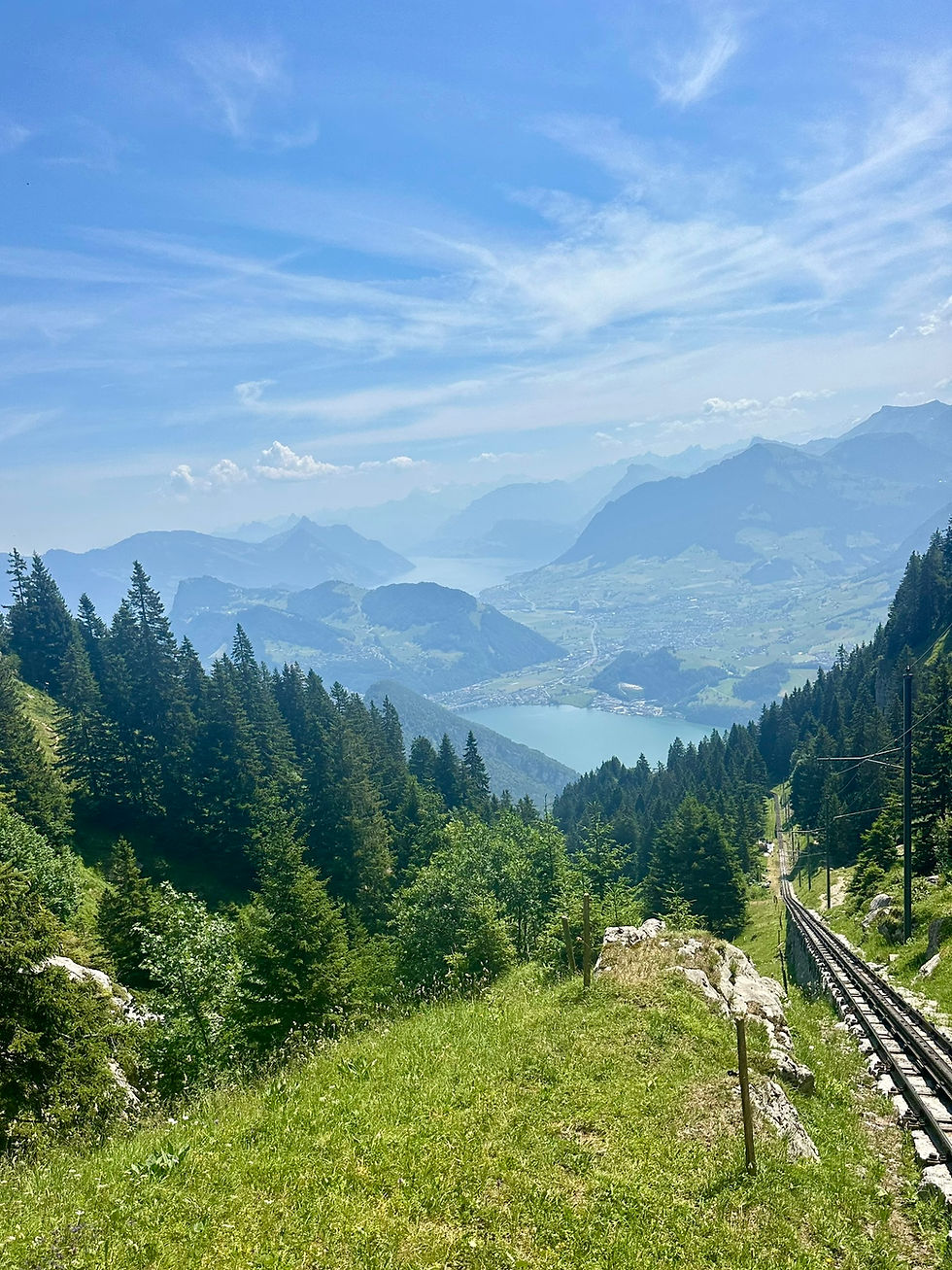
The line climbs from the lakeside at Alpnachstad through forests, meadows and exposed mountain slopes before reaching Pilatus Kulm at over 2,000 metres.
Even today, the engineering feels improbable.
The train does not simply climb the mountain.
It grips it.
The gradient becomes startling in places, with the red carriages tilting sharply as Lake Lucerne falls away below.
For rail travellers, this is one of those journeys where the transport is not just a way to reach the destination.
It is the reason to go.
The Best Way to Do It: The Golden Round Trip
The classic route is known as the Golden Round Trip.
It begins in Lucerne with a boat across Lake Lucerne to Alpnachstad.
From there, the cogwheel railway climbs to Pilatus Kulm.
After time at the summit, you descend the other side by aerial cableway and panoramic gondola to Kriens, then return to Lucerne by bus.
The route works beautifully because you never repeat yourself.
Lake.
Cogwheel railway.
Summit.
Cable car.
Gondola.
Bus.
Each stage feels different.
The boat gives the journey a slow, scenic beginning. The cogwheel railway provides the drama. The summit delivers the views. The cable car descent gives a final sweep across forest and mountain before you return to the city.
If you only have one day in Lucerne, this is one of the best ways to use it.
Getting There from Lucerne
The easiest starting point is Lucerne’s main railway station and lakeside boat pier.
The boat to Alpnachstad leaves from the piers directly outside the station area, making the connection very straightforward.
From Alpnachstad, the cogwheel railway station sits beside the boat landing and railway station.
On the return, the cableway and gondola bring you down to Kriens. From there, local buses return to Lucerne quickly and easily.
Everything is designed to connect.
That is one of the great pleasures of travelling in Switzerland.
When to Go
The full Golden Round Trip is seasonal.
The cogwheel railway normally operates from spring to late autumn, while the boat element has a shorter operating season. In 2026, the cogwheel railway is scheduled to run from 11 May to 29 November, while the full boat-based Golden Round Trip operates until 18 October.
This matters.
Outside the full operating season, you can still usually reach Pilatus via the Kriens cable car route, but the classic circular journey is not always possible.
For the full experience, aim for late May to early October.
June, September and early October can be particularly good months, with fewer crowds than high summer and a better chance of comfortable walking conditions.
The Weather Question
Pilatus is a mountain, and the weather matters.
A perfect day in Lucerne does not always guarantee clear views at the summit.
Cloud can sit around the ridge while the lake remains bright below.
For that reason, it is usually wise not to book too far ahead unless you are travelling in peak season and have no flexibility.
The best approach is to watch the weather closely, check summit webcams if available, and book once the forecast looks promising.
If you are visiting in July, August or on a weekend, you may still need to secure a cogwheel railway seat reservation to avoid long waits.
The balance is simple.
Do not book blindly weeks ahead if the weather is uncertain.
But do not arrive at midday in peak season expecting unlimited space either.
Tickets, Reservations and How to Save Money
Pilatus can be expensive, but there are ways to make the trip more affordable.
The standard round-trip fares vary depending on route and whether you include the boat, train or bus sections. The Silver Round Trip, which uses train and bus rather than the boat, is usually slightly cheaper than the full Golden Round Trip.
Travellers with a Swiss Half Fare Card usually receive around 50% off much of the journey.
This can make a significant difference.
SBB also sometimes offers Mountain’n’Rail deals for Pilatus, which can combine public transport with a discounted mountain railway ticket. These offers change, so it is always worth checking SBB’s leisure offers before buying directly.
A Saver Day Pass can also help with the public transport portion of the journey, especially if you are travelling from elsewhere in Switzerland to Lucerne on the same day. However, it will not necessarily cover the entire mountain railway section to Pilatus Kulm, so always check the exact validity before assuming it is the cheapest option.
The practical advice is this:
Compare three options before booking.
The official Pilatus ticket.
The SBB Mountain’n’Rail offer.
Your fare with a Swiss Half Fare Card or Saver Day Pass.
For many visitors, the Swiss Half Fare Card gives the simplest and most reliable saving, particularly if Pilatus is part of a wider Swiss rail itinerary.
How Long to Spend at the Top
Do not rush the summit.
At an absolute minimum, allow two hours at Pilatus Kulm.
That gives time to enjoy the terraces, walk to the viewpoints, have a coffee or lunch and take in the scale of the landscape.
Three hours is better.
If you want to walk to Tomlishorn, explore the Dragon Path and enjoy the summit properly, allow half a day from arrival at the top before beginning the descent.
For the full Golden Round Trip from Lucerne, most travellers should allow at least five hours.
A slower version with lunch and walking can easily take seven hours.
That is not a problem.
It is the point.

What You See from the Summit
The view from Pilatus Kulm is one of the most dramatic in central Switzerland.
Lake Lucerne spreads below in irregular blue arms, broken by peninsulas, villages and forested slopes.
The city of Lucerne appears small and orderly in the distance.
Beyond the lake, layers of mountains rise in every direction.
On a clear day, the panorama can feel almost overwhelming.
What makes Pilatus especially rewarding is the contrast.
You are not deep in a remote alpine valley.
You are high above one of Switzerland’s most beautiful cities, looking across lake, town, pasture and peaks in a single sweep.
Facilities at the Top
Pilatus Kulm is well set up for visitors.
There are restaurants, terraces, indoor viewing areas, toilets, shops and hotels at the summit.
This makes it a practical mountain excursion even for travellers who do not want a strenuous hiking day.
You can do almost nothing beyond taking in the view and still have a memorable experience.
That said, the summit is much more rewarding if you walk at least a little.
Easy Walks at the Summit
The easiest walk is the Dragon Path.
This short route leads through tunnels and openings in the rock, with dramatic views across the mountain and down towards the lake.
It is ideal if the weather is changeable because parts of it are sheltered.
Another worthwhile short walk is to the Esel viewpoint.
It is close to Pilatus Kulm and gives one of the best summit panoramas without requiring a major hike.
Both are ideal if you only have limited time or are travelling with mixed fitness levels.
The Tomlishorn Walk
If conditions are good, the walk to Tomlishorn is the classic summit route.
Tomlishorn is the highest point of the Pilatus massif, and the path from Pilatus Kulm is one of the most rewarding short hikes in the area.
Allow around 40 minutes each way, depending on pace and conditions.
The route is not technically difficult, but it is exposed in places and requires sensible footwear.
Do not attempt it in poor visibility, strong wind or snow.
On a clear day, however, it is magnificent.
The crowds thin quickly once you leave the main summit area, and the views become broader and wilder with every step.
Walking Down Part of the Mountain
Pilatus is not only about riding up and down.
There are intermediate stations and hiking routes that allow you to combine transport with walking.
One option is to descend part of the way on foot towards Ämsigen, one of the cogwheel railway stops between Pilatus Kulm and Alpnachstad.
This gives a very different perspective on the mountain.
Instead of simply watching the slope from the train, you move through pastures, ridges and changing vegetation on foot.
The walk down is steep in sections and should only be attempted in good weather with proper shoes, but it can be a rewarding choice for active travellers.
More ambitious hikers sometimes descend all the way towards Alpnachstad or Kriens, but these are substantial routes and should be treated as proper mountain hikes rather than casual walks.
For most visitors, a short summit walk plus the full round trip gives the best balance of scenery, comfort and time.
The Kriens Side: Fräkmüntegg and the Dragon Ride
The descent towards Kriens adds another layer to the day.
From Pilatus Kulm, the Dragon Ride aerial cableway drops dramatically towards Fräkmüntegg.
The views are wide and immediate, with Lake Lucerne, forest and mountain slopes opening below.
At Fräkmüntegg, families often pause for the rope park or summer toboggan run, depending on the season.
From there, smaller panoramic gondolas continue down towards Kriens, passing gradually from alpine scenery into forest and then back towards the edge of Lucerne.
It is a gentler, softer ending after the drama of the cogwheel railway.

How to Do Pilatus Well
Start early.
The mountain is far more enjoyable before the main crowds arrive.
If the weather forecast is clear, take the first reasonable boat or train connection from Lucerne.
Travel up by boat and cogwheel railway if the full Golden Round Trip is running.
Reserve a cogwheel railway seat in busy periods.
Bring layers, even in summer.
Wear proper shoes if you plan to walk.
Check the webcam before committing.
Do not treat the summit as a ten-minute photo stop.
And most importantly, build in enough time.
Pilatus works best when the day feels generous rather than rushed.
Getting to Lucerne
Lucerne is one of Switzerland’s easiest cities to reach by train.
From Zurich Airport, direct trains to Lucerne usually take around 1 hour 10 minutes.
From Zurich city centre, the journey is around 45–50 minutes.
From Basel, allow roughly 1 hour to 1 hour 15 minutes.
From Geneva Airport, the journey is longer, usually around three hours, but straightforward with good connections.
This makes Lucerne an excellent first or second stop on a Swiss rail itinerary.
The station sits directly beside the lake and old town, so arrival by train is particularly easy.
Where to Stay in Lucerne
Hotel des Balances is one of Lucerne’s most atmospheric places to stay.
Set directly on the River Reuss in the old town, it combines historic character with one of the city’s most photogenic riverfront settings. Rooms with balconies are especially memorable, and the location is ideal for travellers arriving by train and exploring on foot. @hotel_des_balances
For a grand lakeside stay, Mandarin Oriental Palace, Luzern brings Belle Époque elegance to the shores of Lake Lucerne.
The hotel feels glamorous without losing its connection to the landscape, with lake and mountain views that work beautifully before or after a Pilatus day trip. @mo_luzern
For something with strong personality, Art Deco Hotel Montana sits above the lake with panoramic views across Lucerne and the surrounding mountains.
Its funicular-style entrance, Art Deco interiors and celebrated terrace make it one of the city’s most distinctive hotels.@artdecohotelmontana
Where to Eat in Lucerne
Restaurant Balances is one of the most beautiful dining rooms in Lucerne, especially in warm weather when tables spill onto the riverfront terrace.
The setting overlooking the Reuss gives it a sense of occasion, while the menu combines Swiss and European influences with polished service.
@hotel_des_balances
Wirtshaus Galliker is the opposite in all the right ways.
A long-standing Lucerne institution, it is the place to go for traditional Swiss cooking, local atmosphere and a meal that feels rooted in the city rather than designed for visitors alone.
Art Deco Hotel Montana’s Scala Restaurant is excellent if you want dinner with a view.
The terrace looks across Lake Lucerne towards the mountains, making it particularly appealing after a day on Pilatus.@artdecohotelmontana
Why Pilatus Is Worth It
Pilatus is popular for good reason.
The journey is varied, the logistics are easy, and the views are among the finest in central Switzerland.
But what makes it special is the combination.
A lake crossing.
The world’s steepest cogwheel railway.
A summit above Lucerne.
Short walks with huge views.
A cable car descent.
And a return to the city without ever needing a car.
It is Switzerland at its most efficient, scenic and satisfying.
Exploring Switzerland by Train
Mount Pilatus is exactly the kind of journey that makes Switzerland such a rewarding country to explore by rail.
The connections are simple, the scenery is spectacular, and the journey itself becomes part of the experience.
For more scenic routes, mountain excursions, practical booking advice and independent itineraries, see Touring Switzerland by Train.
Find the guide here:
You can also discover more rail journeys and slow-travel inspiration at:
Follow along at:
@real_travel_guides


Comments