
Feria del Caballo in Jerez: Horses, Sherry and Andalucía at Its Most Spectacular
There is something genuinely special about experiencing the Feria del Caballo. It feels like a privilege to witness a celebration that remains so deeply rooted in the life of Jerez, where generations of families come together to celebrate their heritage, traditions, music, horses, food and friendship.
For one week each spring, Parque González Hontoria is transformed into a temporary city of lanterns, striped casetas, flamenco dresses, horse-drawn carriages and immaculately turned-out Andalusian horses.
By day, riders and carriages move slowly along the sandy avenues beneath the trees.
Families gather for long lunches inside the casetas.
Glasses of chilled fino and rebujito appear on tables.
Then evening arrives, thousands of lights illuminate the fairground, and the music and celebration continues long into the night.
The Feria del Caballo is often translated simply as the Jerez Horse Fair.
But that description barely captures it.
This is a celebration of the three traditions that define the city:
horses,
flamenco,
and sherry.
It is also one of the easiest major Andalusian festivals to experience independently.
Jerez is directly connected by train with Seville and Cádiz, the fairground is close to the centre, and most of its casetas are open to the public.
No car is required.
No private invitation is needed.
You simply arrive and become part of it.
When Is the Feria del Caballo?
The Feria del Caballo usually takes place during spring, commonly in May, although the dates can shift from year to year according to the local calendar.
The celebration normally lasts for one week and begins with the ceremonial lighting of the fairground.
Because accommodation fills quickly, it is worth checking the confirmed dates well before booking your trip.
The official Jerez tourism website publishes the annual programme, including opening times, equestrian competitions, concerts and transport information.
For the best overall experience, stay for at least two nights.
That allows you to see the fair in daylight, when the horses and carriages are the main attraction, and again after dark, when the illuminated entrance and casetas create a completely different atmosphere.
Why the Feria Is So Special
Andalucía has several famous spring fairs.
What sets Jerez apart is the prominence of the horse.
This is not a decorative theme added for visitors.
Horses are deeply connected to the identity, economy and culture of the city.
Jerez has long been associated with the breeding and training of the Spanish horse, with its controlled movement, intelligence and unmistakable presence.
During the Feria, that tradition moves out of riding schools and private estates and into the public streets of the fairground.
The Paseo de Caballos is the defining sight.
Riders wearing traditional Andalusian dress guide their horses through the avenues, accompanied by polished carriages filled with families and groups of friends.
The pace is deliberate rather than hurried.
This is a promenade.
A chance to see and be seen.
The careful presentation of the horses, riders, harnesses and carriages is part of the spectacle, but so is the ease with which the tradition appears to fit into everyday local life.
That is why the Feria feels so much more compelling than a staged equestrian show.

From Medieval Livestock Fair to Andalusian Celebration
The origins of the Feria del Caballo stretch back to 1284, when King Alfonso X granted Jerez the right to hold a livestock fair.
These gatherings were important commercial events.
Farmers, breeders and merchants came together to buy and sell animals, exchange information and negotiate business.
Jerez was ideally positioned for this.
The surrounding countryside supported agriculture, cattle and horse breeding, while the city sat within trading routes connecting inland Andalucía with the Atlantic coast.
Over the centuries, the commercial fair gradually developed a more social character.
Food, music and entertainment became increasingly important.
Temporary refreshment stalls evolved into decorated casetas.
The horse market became a public equestrian display.
What began as an agricultural gathering eventually became one of Spain’s most distinctive festivals.
The modern Feria still preserves that connection with its origins.
Beneath the music, dresses and celebration, the horse remains at its centre.
The Setting: Parque González Hontoria
The Feria takes place in Parque González Hontoria, a broad green space north of Jerez’s historic centre.
During the festival, the park is transformed.
Temporary casetas line avenues covered in pale albero sand.
Flowers, lanterns and decorative façades turn each structure into something between a private clubhouse, restaurant and dance hall.
The main entrance changes in design and is illuminated by thousands of lights after dark.
Unlike a conventional festival site, there is no single stage or central attraction.
The pleasure lies in moving through it.
You walk beneath the trees.
Stop to watch the horses.
Enter a caseta for food or a drink.
Listen to flamenco.
Move on again.
The Feria works through accumulation rather than a fixed itinerary.

The Casetas: Why Jerez Is So Welcoming
One of the most important things for first-time visitors to understand is that the casetas in Jerez are generally open to the public.
This makes the Feria del Caballo significantly easier to enjoy than fairs where many casetas are private and entry depends on knowing a member.
Each caseta has its own personality.
Some are traditional and family-oriented.
Others are run by restaurants, associations, businesses or social groups.
Some focus on food.
Others become lively dance venues after dark.
You do not need to commit to one.
The best approach is to wander, look inside and stop wherever the atmosphere appeals.
Menus and prices are normally displayed, and many casetas serve full meals as well as smaller plates.
Expect local dishes, fried fish, jamón, cheese, seafood, stews and plenty of sherry.
During the evening, music becomes louder and spontaneous dancing is common.
You do not need to understand every convention.
Be respectful, observe the atmosphere and join in where it feels natural.
What to Drink
Jerez gave its name to sherry, and the Feria is one of the best places to see how naturally the wine fits into local life.
Fino is the classic choice.
Served chilled, it is dry, fresh and particularly well suited to seafood, jamón and salty snacks.
You will also see plenty of rebujito, a long, cold drink made by mixing fino or manzanilla with a lemon-lime soft drink and serving it over ice.
It is refreshing and deceptively easy to drink.
Order by the glass or share a jug with the table.
Pace yourself.
The Feria begins early, continues late and is best enjoyed as a long social occasion rather than a rushed night out.
What to Wear
Visitors do not need traditional clothing to attend.
Smart but comfortable clothes are perfectly acceptable.
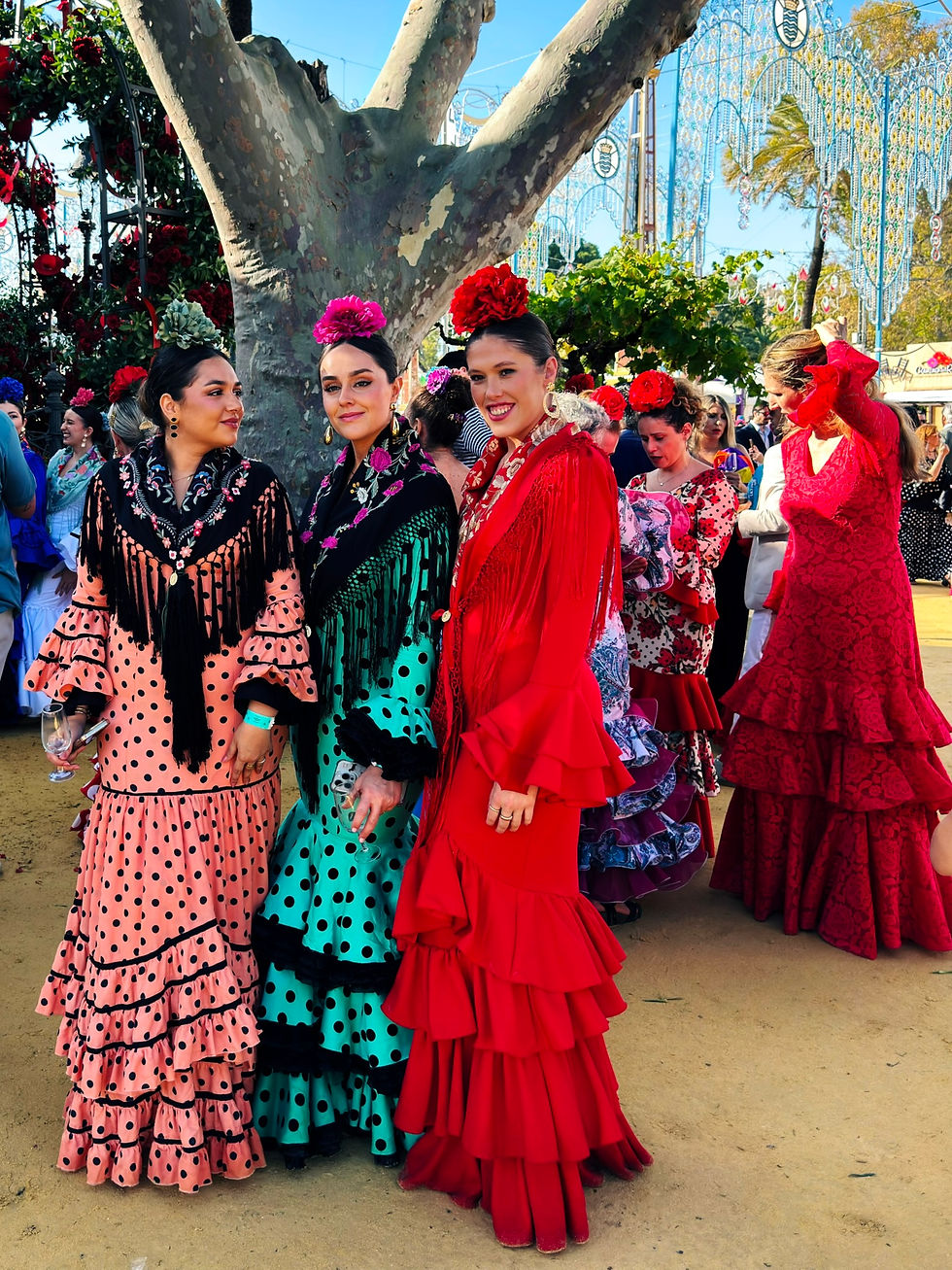
That said, the Feria is a visually elegant event, and many local people make a real effort.
Women often wear colourful flamenco dresses, particularly during the main days of the fair.
Men may wear jackets, shirts or traditional riding clothing if participating in the equestrian events.
Comfortable footwear matters.
The fairground is large, the surface is sandy and you may be standing or walking for several hours.
Avoid delicate shoes and anything that will become uncomfortable in heat or dust.
May in Jerez can already feel very warm during the afternoon, but evenings may cool once the sun goes down.
Bring a light layer if you plan to stay late.
The Best Time to Visit
If your main interest is the horses, arrive around lunchtime and stay through the afternoon.
The Paseo de Caballos takes place during the day, when riders and carriages move through the fairground and the light is best for photography.
This is when your reel footage is likely to feel at its most distinctive.
The polished horses, traditional clothing and colourful casetas all appear against the pale sand and green trees.
Late afternoon brings a gradual change.
The horses begin leaving, the casetas become busier and attention shifts towards eating, drinking and dancing.
After dark, the lights transform the site completely.
For a first visit, try to experience both.
Arrive in the early afternoon.
Watch the horse parade.
Stop for a late lunch.
Stay as the entrance and avenues light up.
You will see two versions of the same festival.
How to Enjoy the Feria Properly
Do not arrive with an overplanned schedule.
The event is best experienced by allowing the atmosphere to guide you.
Begin with a slow walk around the fairground to understand its scale.
Watch the horses before settling into a caseta.
Order a drink and a few shared dishes rather than committing immediately to a large meal.
Move between different casetas during the afternoon and evening.
Some will be quiet and traditional.
Others will be full of music and dancing.
Weekdays are usually easier for first-time visitors than the busiest weekend periods.
The fairground still feels lively, but it is often easier to find tables and appreciate the horses without the largest crowds.
Families and older visitors tend to dominate earlier in the day.
The atmosphere becomes younger and more energetic late at night.
Choose the time that suits the experience you want.

Practical Feria Tips
Book accommodation as soon as the dates are confirmed.
Hotels in central Jerez fill quickly, and prices rise as the event approaches.
Do not drive to the fairground.
Parking restrictions and crowds make rail, walking, taxis and local buses far more convenient.
Download or consult the city’s annual Feria map, which shows casetas, access points, services and scheduled events.
Carry a small amount of cash, although many casetas now accept cards.
Drink water regularly, especially if the afternoon is hot.
Protect yourself from the sun.
Agree on a meeting point if visiting in a group, as the fairground becomes extremely busy after dark.
Most importantly, remember that this is a living local celebration.
Photograph respectfully, particularly around horses, riders and families.

Getting to Jerez by Train
Jerez de la Frontera is exceptionally easy to reach by rail.
From Seville Santa Justa, direct Renfe trains normally take around 50 minutes to just over an hour.
Services operate throughout the day, making Jerez possible as a day trip.
However, during the Feria, staying overnight is strongly recommended.
The celebration continues long after the most convenient return trains, and the evening illumination is a major part of the experience.
From Cádiz, direct commuter and regional trains generally take around 35–45 minutes.
This makes Jerez an easy addition to a wider trip along the Costa de la Luz.
From Córdoba, Málaga or Madrid, longer-distance services and connections make Jerez accessible as part of a wider Andalusian rail itinerary.
Jerez railway station is close to the centre.
From there, you can walk into the historic district, take a taxi to your hotel or use local transport to reach Parque González Hontoria.
During Feria week, additional transport arrangements may operate, so check the annual municipal information before travelling.
Can You Visit as a Day Trip?
Yes.
From Seville or Cádiz, Jerez is one of Andalucía’s easiest festival day trips by train.
Take an early service, explore the historic centre in the morning, then head to the Feria for the afternoon horse parade.
However, a day trip means missing some of the atmosphere after dark or watching the clock for your final train.
One night is much better.
Two nights is ideal.
That gives you one full Feria day and another day to explore the horses, bodegas and history of Jerez itself.
Jerez Beyond the Feria
The Feria may bring you to Jerez.
The city gives you plenty of reasons to stay.
Jerez has often been overshadowed by Seville, Cádiz and Córdoba, but it possesses one of the clearest cultural identities in Andalucía.
Horses, sherry and flamenco are not separate attractions here.
They overlap constantly.
A morning at the riding school can lead naturally into a bodega lunch, an afternoon exploring Moorish architecture and an evening listening to flamenco inside a traditional tabanco.
The Royal Andalusian School of Equestrian Art
For anyone drawn to Jerez by the Feria, the Royal Andalusian School of Equestrian Art should be a priority.
Its famous performance, How the Andalusian Horses Dance, is often described as an equestrian ballet.
That is not an exaggeration.
Horses and riders perform carefully choreographed movements based on classical dressage, traditional ranch work and doma vaquera, accompanied by Spanish music and period-style costumes.
The control is extraordinary.
So is the relationship between horse and rider.
The school occupies elegant grounds around the Palacio del Recreo de las Cadenas and also includes museums, training areas and historic carriages.
Performances do not necessarily take place every day, so check the calendar and book ahead.
During Feria week, demand is particularly high. @realescuela

Discovering Sherry
You cannot understand Jerez without entering a bodega.
The city’s distinctive cathedral-like wine warehouses were designed to create stable conditions for ageing sherry.
Inside, rows of black barrels stretch beneath high ceilings while the air carries the unmistakable scent of wine, timber and cool stone.
González Byass is the most famous name and the home of Tío Pepe.
Its extensive bodega complex sits close to the Alcázar and offers a polished introduction to the history, production and ageing of sherry. @tiopepewines
For a smaller and more specialised experience, Bodegas Tradición combines exceptional old sherries with an important private collection of Spanish art.
The visit offers something unusual: historic wines alongside works associated with artists such as Goya, Velázquez and El Greco. @bodegastradicion
Whichever bodega you choose, book in advance during Feria week.

The Alcázar of Jerez
The Alcázar is one of the city’s most important historic sites.
Built during the Almohad period, it preserves defensive walls, a mosque, Arab baths, gardens and later Christian additions.
The complex reveals the importance of Jerez during Muslim rule and the way the city evolved after the Christian conquest.
It is calm, compact and easy to combine with a nearby bodega visit.
The gardens provide welcome shade, while the tower and camera obscura offer a broader perspective over the city.

Jerez Cathedral and the Historic Centre
Jerez Cathedral rises above the old city in a mixture of Gothic, Baroque and Neoclassical forms.
Its scale reflects the prosperity generated by wine and trade.
Nearby streets lead towards plazas, bodegas, churches and traditional tabancos.
Allow time to wander rather than moving directly between landmarks.
Jerez is at its most convincing in the spaces between them:
a quiet square,
a tiled doorway,
the smell of sherry drifting from a warehouse,
or flamenco beginning unexpectedly inside a bar.
Flamenco in the Tabancos
A tabanco is part wine shop, part tavern and part social institution.
Traditionally, these were places where sherry was served directly from barrels and locals gathered to talk, sing and listen to flamenco.
Tabanco El Pasaje is one of the best-known places to experience this tradition.
The room is small, atmospheric and often hosts live performances at close range.
It can become busy, especially during Feria week, but the intimacy is part of the appeal.
@tabancoelpasaje
Where to Stay in Jerez
Hotel Bodega Tío Pepe
For travellers who want to immerse themselves in the city’s wine culture, Hotel Bodega Tío Pepe is difficult to beat.
Set within the historic González Byass complex, it combines contemporary boutique design with direct views of the cathedral and immediate access to some of Jerez’s most famous bodegas.
The rooftop pool and terrace are especially appealing after a busy afternoon at the Feria. @hotelbodegatiopepe
Casa Palacio María Luisa
Casa Palacio María Luisa offers a more intimate form of luxury.
Occupying a restored 19th-century palace, the hotel has elegant rooms, calm courtyards and a garden that feels far removed from the noise of Feria week.
It works particularly well for travellers who want a sophisticated central base within walking distance of the old town. @casapalaciomarialuisa
Where to Eat in Jerez
La Carboná
Set inside a former sherry bodega, La Carboná is one of the restaurants that best expresses the relationship between Jerez’s food and wine.
Many dishes are designed around specific styles of sherry, showing how fino, oloroso, amontillado and Pedro Ximénez can work alongside seafood, meat and desserts.
The setting is atmospheric without feeling overly formal. @la_carbona
Mantúa
For a more ambitious dining experience, Mantúa offers contemporary tasting menus by chef Israel Ramos.
The cooking draws on Cádiz, the Atlantic and the landscapes surrounding Jerez, presenting local ingredients with precision and imagination.
It is an excellent choice for a special dinner away from the fairground.
@restaurantemantua
Albores
Albores is centrally located and more relaxed, making it a useful option for visitors who want modern Andalusian cooking without committing to a long tasting menu.
The menu mixes traditional flavours with contemporary presentation, and the restaurant is well placed for an evening in the historic centre. @restaurantealbores
What to Eat at the Feria
The casetas are part of the experience, so plan at least one meal inside the fairground.
Look for plates designed for sharing.
Jamón ibérico.
Local cheeses.
Tortillitas de camarones.
Fried fish.
Croquetas.
Stews.
Grilled meats.
And dishes cooked with sherry.
A jug of rebujito may be the classic Feria drink, but try a glass of chilled fino with food as well.
It offers a much clearer sense of why sherry remains so central to local culture.
A Two-Night Feria Itinerary
Arrive in Jerez by train on the first afternoon.
Check into your hotel and spend the early evening exploring the historic centre.
Visit a tabanco or have dinner at La Carboná or Albores.
The next morning, visit the Alcázar and cathedral or book the dancing horses at the Royal Andalusian School.
Have a light lunch, then head to the Feria in time for the Paseo de Caballos.
Stay through the afternoon and into the evening as the lights come on.
On your final morning, visit a sherry bodega before continuing by train to Seville, Cádiz or elsewhere in Andalucía.
This gives you a full experience without trying to fit too much into one day.
Why Jerez Works So Well by Train
Jerez demonstrates exactly why festival travel and rail travel work so well together.
The station brings you close to the centre.
The city is compact.
The fairground can be reached without driving.
And direct services connect Jerez with two of Andalucía’s most useful bases: Seville and Cádiz.
You can arrive in the morning, watch Andalusian horses parade through the fairground by afternoon, drink sherry inside an open caseta and return to a historic hotel without once worrying about parking.
Better still, stay long enough to discover that Jerez is far more than its Feria.
It is one of Spain’s most distinctive cultural cities.
Why the Feria del Caballo Is Worth Planning Around
The Feria is visually spectacular.
But its real strength lies in how naturally the different elements come together.
The horses are not a sideshow.
The sherry is not a tourist tasting.
The flamenco is not added as entertainment.
All three belong to Jerez.
For visitors, the Feria offers a rare opportunity to experience those traditions not in isolation, but as part of a living celebration shared across the city.
Come for the photographs.
Stay for the atmosphere.
And allow enough time to understand the place behind the spectacle.
Exploring Spain by Train
Jerez is exactly the kind of destination that makes independent rail travel in Spain so rewarding.
It combines excellent train connections with deep local culture, remarkable food, historic architecture and experiences that cannot simply be replicated elsewhere.
For more routes, practical transport advice, hidden destinations and flexible itineraries, see Touring Spain by Train.
The guide is designed to help you explore the country independently, without relying on organised tours or hiring a car.
Find the guide here:
You can also discover more rail journeys, festivals and slow-travel inspiration at:
Follow along at:
@real_travel_guides


Comments