
Tarifa and the Dunes of Valdevaqueros Without a Car: Where Europe Meets Africa
Some beaches are beautiful.
Others feel symbolic.
Tarifa belongs firmly in the second category.
This is the southernmost point of mainland Europe, where the Atlantic meets the Mediterranean and Morocco appears across the Strait of Gibraltar like another world just beyond reach.
The wind is part of the atmosphere.
So are the kites.
So are the wide beaches, whitewashed streets, surf shops, Moroccan influences and the sense that Tarifa sits at the edge of something.
Most visitors assume you need a car to reach it properly.
You do not.
With a train to Algeciras, a short bus connection to Tarifa, and a local bus or taxi to Valdevaqueros, it is entirely possible to experience this spectacular corner of Andalucía independently.
No hire car.
No coastal driving.
No parking stress.
Just one of Spain’s most dramatic landscapes, reached by public transport.
Why Visit Tarifa?
Tarifa feels different from almost everywhere else in Spain.
It is not polished in the way Marbella can be.
It is not monumental like Seville or Granada.
Its appeal is more elemental.
Wind.
Sea.
Sand.
Light.
Africa on the horizon.
The old town is compact and atmospheric, with narrow lanes, white buildings, small bars and a relaxed surf-town energy. Beyond the town, the coastline opens into some of Andalucía’s most spectacular beaches.
The most dramatic of all is Valdevaqueros.
Here, a vast sand dune rises behind the beach, shaped by the powerful winds that have made Tarifa one of Europe’s great kitesurfing capitals.
It is wild, beautiful and completely unlike the more manicured Spanish beach resorts many visitors expect.

Getting There Without a Car
Tarifa itself does not have a railway station.
That is the important thing to understand.
The nearest useful rail hub is Algeciras.
From Seville, the journey normally involves taking a Renfe service towards Algeciras, then continuing by bus to Tarifa.
Once in Algeciras, regular buses connect to Tarifa in around 30–40 minutes. The journey is straightforward and inexpensive, with services running throughout the day.
From Tarifa town, Valdevaqueros is around 10 kilometres away.
In summer, local buses sometimes serve the beach areas, but schedules can be limited. A taxi is the easiest option if you want to reach the dune without complications.
For independent travellers, the best plan is simple:
travel to Tarifa,
stay overnight,
visit Valdevaqueros early or late in the day,
and avoid trying to rush everything as a single day trip.
The Best Base: Tarifa or Algeciras?
Although Algeciras is the railhead, Tarifa is where you want to stay.
Algeciras is practical.
Tarifa is the destination.
By staying in Tarifa, you can enjoy the old town in the evening, visit Valdevaqueros when the light is best, and avoid worrying about late onward connections.
A one-night stay is possible.
Two nights is better.
That gives you time for the old town, the beach, the dune, sunset and perhaps even a ferry glimpse across to Morocco.

A Brief History of Tarifa
Tarifa’s position has shaped its entire history.
The town sits at one of the most strategic points in Europe, controlling the narrow sea passage between Spain and North Africa.
Its name is usually linked to Tarif ibn Malik, the Berber commander associated with the early Muslim landing in this region in the 8th century.
For centuries, this coastline was contested, fortified and watched.
Romans, Moors, Christians, pirates, traders and armies all understood the importance of the Strait.
The town’s most important monument is the Castle of Guzmán el Bueno, built in the 10th century under the Umayyad Caliphate of Córdoba.
It later became associated with one of Spain’s most famous medieval legends, when Alonso Pérez de Guzmán, known as Guzmán el Bueno, refused to surrender the fortress even when his enemies threatened his son.
Whether approached as history, legend or political myth, the castle remains central to Tarifa’s identity.
The Old Town
Tarifa’s old town is small but full of character.
Enter through Puerta de Jerez and the atmosphere changes almost immediately.
Whitewashed streets lead to tiny squares, surf shops, tapas bars, guesthouses and cafés. Laundry hangs from balconies. Scooters squeeze past old stone walls. The whole place feels relaxed but lively, especially in the evening when the wind drops and restaurants begin filling.
Unlike larger Andalusian cities, Tarifa does not overwhelm with monuments.
It works through mood.
The pleasure lies in wandering without a strict plan.
Castle of Guzmán el Bueno
The castle is the one historic sight you should not miss.
Standing close to the harbour, it reminds visitors that Tarifa was never just a beach town.
This was a frontier.
A defensive stronghold.
A place where Europe and Africa faced one another across one of the world’s most important sea routes.
From the castle walls, the views across the Strait are superb.
On a clear day, Morocco feels astonishingly close.
Isla de las Palomas
At the southern edge of Tarifa lies Isla de las Palomas, connected to the mainland by a causeway.
This is the point where the Atlantic and Mediterranean meet.
Walking here gives a powerful sense of geography.
One side faces the open Atlantic.
The other turns towards the Mediterranean.
Behind you lies Spain.
Ahead lies Africa.
Few places make Europe’s position in the world feel quite so visible.
Valdevaqueros: Tarifa’s Most Spectacular Beach
Valdevaqueros is the visual heart of this trip.
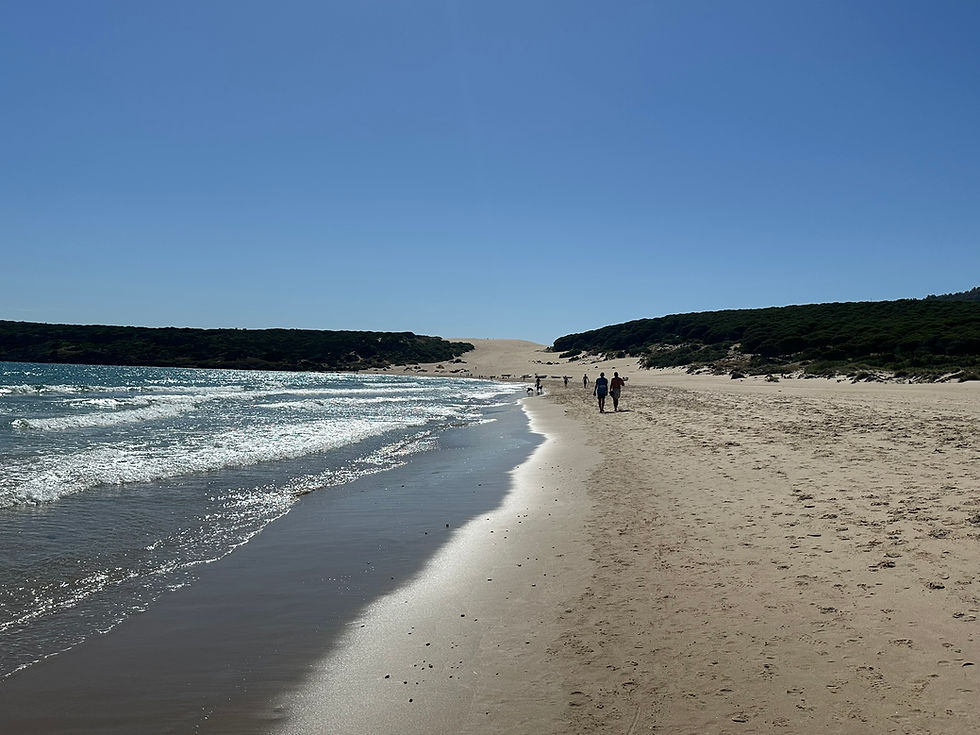
The beach is wide, open and wind-swept, backed by hills, dunes and the constant movement of kitesurfers.
This is not a sheltered swimming cove.
It is a place of space and motion.
The wind can be intense.
That is precisely why people come.
Kites fill the sky in bright arcs of colour, boards skim across the waves, and the whole landscape feels alive.

Duna de Valdevaqueros
The Duna de Valdevaqueros is one of the most striking natural features on this stretch of coast.
A huge sweep of pale sand rises above the beach, shaped and reshaped by the Levante wind.
Climb carefully to the top and the views are extraordinary.
Below you lies the beach.
Beyond it, the Strait.
Further still, the mountains of Morocco.
Behind you are pine trees, coastal hills and the road back towards Tarifa.
It is one of those places that looks impressive on video but feels even more dramatic in person.
Go early in the morning or late in the afternoon if you can.
The light is softer, the sand is cooler and the dune feels far more atmospheric.
Sunset can be spectacular.
The Wind: What You Need to Know
Tarifa’s wind is legendary.
There are two main winds visitors hear about.
The Poniente blows from the west and is usually cooler, fresher and more comfortable.
The Levante blows from the east and can be hot, strong and relentless.
For kitesurfers, wind is the point.
For beachgoers, it can completely change the experience.
If you want a relaxed beach day, check the forecast before heading to Valdevaqueros.
If the Levante is blowing hard, expect flying sand, strong gusts and a much wilder atmosphere.
That said, dramatic wind can make your footage look incredible.
Kitesurfing and Beach Culture
Tarifa is one of Europe’s great kitesurfing centres.
Even if you have no intention of trying it, watching the kites at Valdevaqueros is part of the experience.
The beach has a confident, international feel.
Spanish, French, German, British and Moroccan influences all mix easily here.
People come for sport, freedom, weather, music and that slightly end-of-the-continent feeling Tarifa does so well.
If you do want to learn, there are numerous kitesurf schools around Tarifa and Valdevaqueros, but beginners should choose carefully and respect the wind conditions.
This is a serious kitesurfing destination, not a novelty activity.
Where to Stay in Tarifa
Kook Hotel Tarifa is a stylish boutique option in the old town, ideal for travellers who want character rather than a standard beach hotel.
The interiors are relaxed and design-led, with a calm atmosphere that suits Tarifa perfectly. Its central location means you can walk everywhere in the evening, from tapas bars to the harbour. @kookhoteltarifa
Hotel & Spa La Residencia Puerto is a more polished option close to the port, with a rooftop pool, sea views and a strong sense of place.
It works particularly well if you want comfort, views and easy access to both the old town and ferry area. @hotellaresidenciatarifa
For travellers who want to stay closer to Valdevaqueros itself, Hotel 100% Fun is one of the area’s most recognisable places to stay.
Set near the beach, with gardens, a pool and a relaxed kitesurf atmosphere, it suits visitors who want to be near the sand rather than in the old town. @100funhotel
Where to Eat in Tarifa
Bar El Francés is one of Tarifa’s best-known casual restaurants, loved for its lively atmosphere, generous plates and excellent seafood and tapas.
It is popular for a reason, so arrive early or be prepared to wait.
@bar_el_frances_tarifa
No.6 Cocina Sencilla offers a more contemporary take on Tarifa dining.
The name suggests simplicity, but the cooking is careful, creative and ingredient-led, making it a strong choice for travellers who want something more refined without losing the relaxed Tarifa mood.
Waikiki Tarifa is ideal for a more relaxed beachside experience.
Set by Playa de Los Lances, it combines food, drinks, music and sunset atmosphere in exactly the way Tarifa does best. @waikikitarifa
If you are staying near Valdevaqueros, the restaurant at 100% Fun is also worth considering.
It focuses on local Cádiz produce, including almadraba red tuna in season, retinto beef, fresh fish and generous outdoor dining near the beach. @100funhotel

What Else to Do in Tarifa
Tarifa rewards slow exploration.
Walk the old town in the morning before it becomes busy.
Visit the castle.
Stand on the causeway to Isla de las Palomas.
Spend time at Playa de Los Lances.
Watch the ferries crossing to Tangier.
Take a whale-watching trip in season.
Or simply sit in a café and enjoy the unusual mix of surf culture, Andalusian history and North African proximity.
If you have more time and transport works for you, Bolonia is another spectacular coastal destination nearby, with Roman ruins at Baelo Claudia and one of the finest beaches in southern Spain.
However, Bolonia is harder without a car, so it is better treated as an extra rather than the centre of a no-car itinerary.

How Long Should You Stay?
One night is enough to get a taste.
Two nights is ideal.
Arrive in Tarifa in the afternoon, explore the old town and have dinner.
Spend the next day at Valdevaqueros and the dune.
Return for sunset and another evening in town.
If you have a third day, add whale watching, more beach time or a slower visit to the castle and old town.
Do not rush this trip.
Tarifa is best when you allow time for the weather, wind and light to shape the experience.
A Smart No-Car Itinerary
Start in Seville.
Take the train towards Algeciras, checking Renfe carefully for current timings and any rail replacement arrangements.
Continue by bus from Algeciras to Tarifa.
Stay overnight in Tarifa old town.
The next morning, take a taxi or local bus towards Valdevaqueros.
Walk the dune early or late in the day.
Return to Tarifa for dinner and sunset.
Travel back the following day, or continue onwards through Andalucía.
Insider Tips
Do not underestimate the wind.
Bring sunglasses even if you are not sunbathing, because sand can blow hard across the beach.
Wear shoes or sandals suitable for hot sand if you plan to climb the dune.
Check bus times in both directions before committing to a tight schedule.
Book accommodation early in summer, especially if you want to stay in Tarifa rather than Algeciras.
Avoid treating this as a rushed day trip from Seville.
The transport is possible, but the whole experience works much better as an overnight or two-night escape.
If you are filming, go late afternoon.
The dune, kites and sea look magnificent as the light begins to soften.
Why This Journey Works
Tarifa and Valdevaqueros prove that rail-based travel in Spain does not have to mean only big cities and famous monuments.
Sometimes the reward lies at the edge of the network.
A train gets you close.
A bus completes the connection.
Then suddenly you are standing on a dune above the Strait of Gibraltar, watching kitesurfers fly across the water with Africa visible on the horizon.
That is the kind of travel moment people remember.
Exploring Spain by Train
Tarifa and Valdevaqueros are exactly the kind of destinations that show how rewarding independent travel in Spain can be.
Even places without their own train station can often be reached with a smart combination of rail and local transport.
For more scenic routes, practical transport advice, hidden destinations and independent itineraries, see Touring Spain by Train.
Find the guide here:
You can also discover more rail journeys and slow-travel inspiration at:
Follow along at:
@real_travel_guides


Comments